Nobody I know1 wants to think too much about what goes on in the bathroom. Look at that euphemism: bath room. Even more obliquely, Americans also call it a restroom. That’s so polite it elides what we’re even doing there. I guess I’m resting? Well, I’m sitting down (sometimes). But I’m not there to rest and I’m not there to bathe.
I spent a week in the lovely city of London recently with my girls and in the dog days of a record-shattering hot summer. We encountered a lot of bathrooms. If I seem preoccupied with what happens there, it’s only because the English are fixated on it. They don’t mince words. Rather than wrestle with oblique references or suggestions about what is happening behind the bathroom door, they simply come out and say it: toilet.
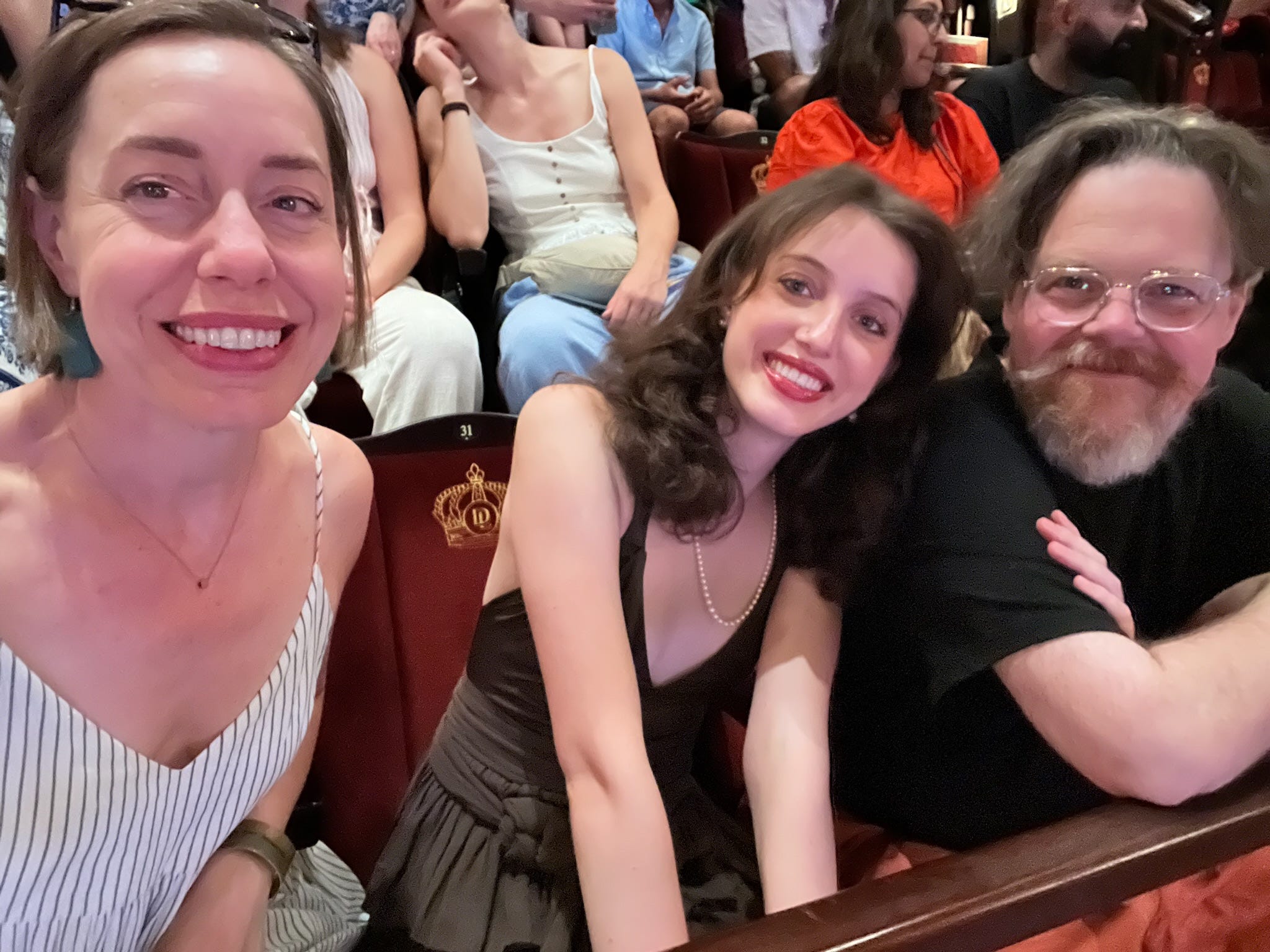
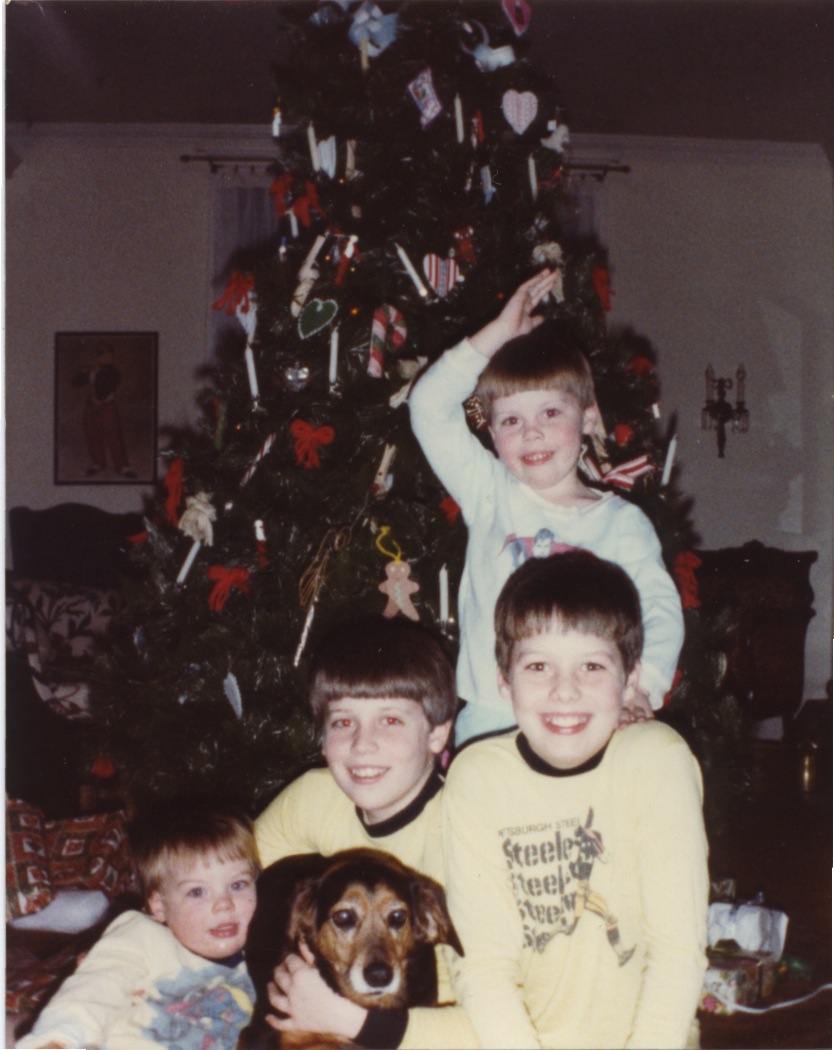
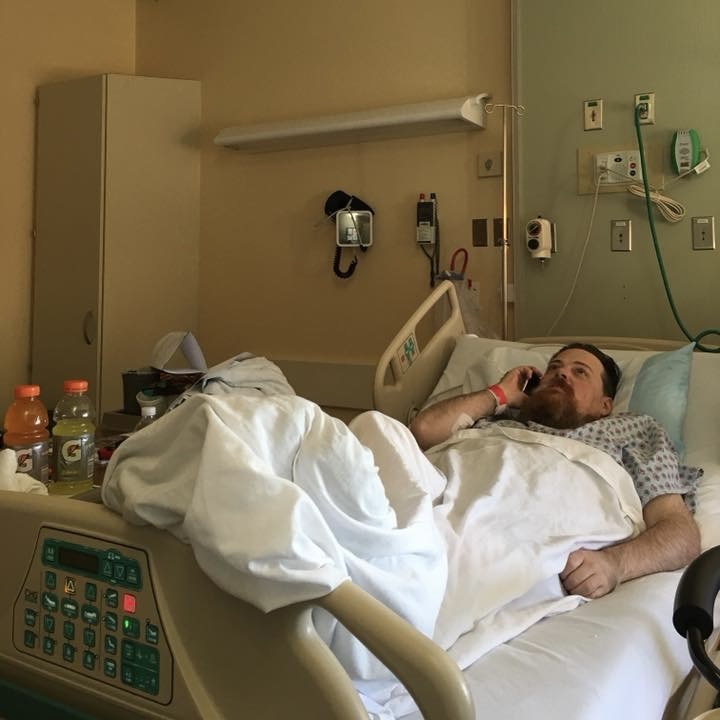
er this is not a toilet, it is Ellen and Louise and me
The English bathrooms get it out of the way immediately. We both know why you’re there. You’re standing or sitting here to put something disgusting from your body into a hole and never see it again. You devote your waste to the mysterious network of pipes underground and trust that something down there knows what to do with it. Not my problem.
Speaking of English toilets, there’s one word that comes to mind: upsetting. The toilets in the UK are deeper than ours, for some reason, like wishing wells. Everything that goes in them sounds like the deployment of a depth charge in a world war 2 submarine movie.
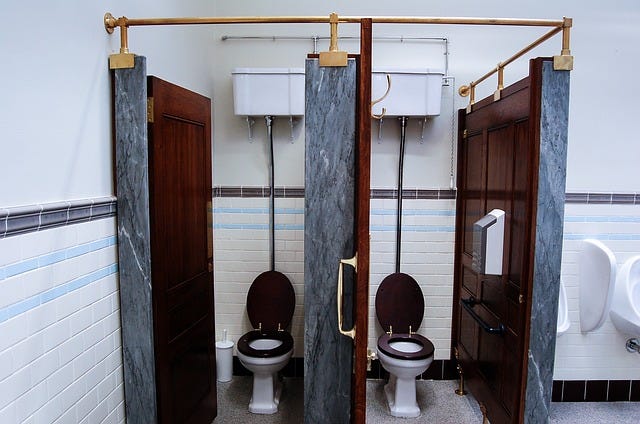
And then the flush — oh the flush! If the flush of an American toilet is a gentle, swirling shower, then the UK flush is a monsoon. If you’re really lucky, you’ll get a toilet with a whimsical pull chain.
summoning servants to the drawing room or committing your filth to the septic system? There’s a pull chain for that
They Say “Poo” and “Wee,” Too
America has colonized the entire world with our culture, so even the English understand what you’re saying when you ask where the restroom is (they might laugh at you, but don’t take it personally). To smooth the way, you should probably remember to call it what they call it: the toilet. If you really must be an embarrassed American, you can call it a water closet (though I can’t promise you won’t get laughed at for that, too).
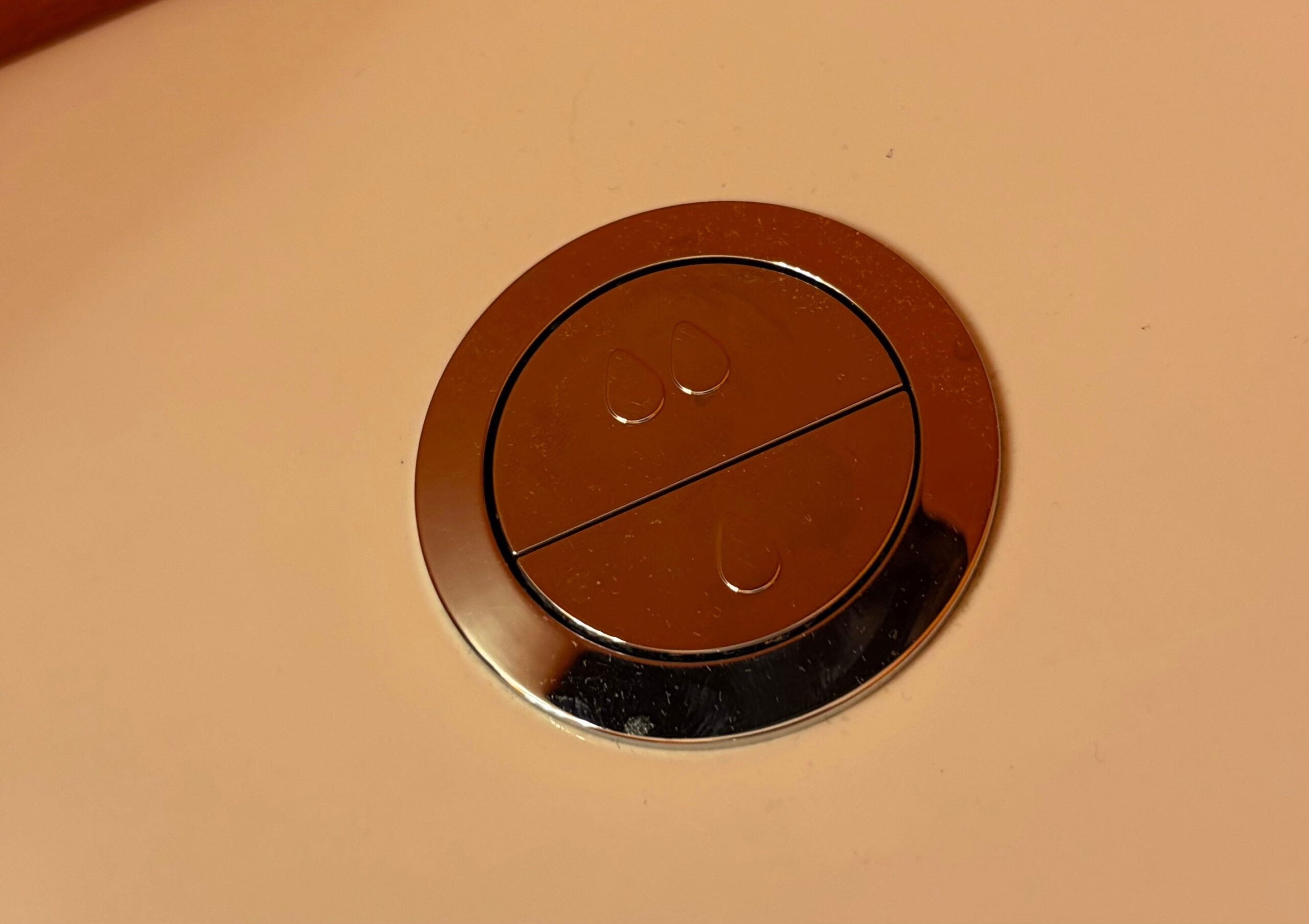
But this isn’t about etymology or wordplay or even my trip to England. It’s about this nightmare:
The Tyranny of a Toilet Button
Renting from the slum lords of a college town provides an unwanted education on how toilets work and how to fix them. It’s much easier to pop the lid to repair a detached flush chain or diagnose a running toilet oneself rather than hope your landlord can take a break from the golf course or whatever to call you a plumber.
This training for life as an adult has made me prefer the lever flush because it’s a technology I understand. I push the handle down, it uncorks the tank, evacuates the bowl, and refills the tank. I know how this device works.
You don’t need any prior knowledge of the mysterious machinery inside the tank top operate it. There’s one lever there on the tank. You can’t miss it. It’s right there. Push the lever down, start the Rube Goldberg operation and go on with your day.
A lifetime of simple binary function has not prepared me for the button. Do my business, stand up, turn to face the tank.
Now I have a side quest.
Which Button Do You Push When?
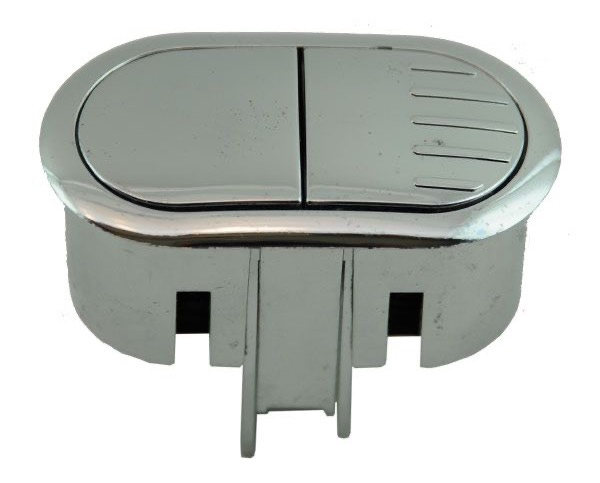
There are two water drops on the top button and only one water drop on the smaller button. Does this mean I need to push the top button when I deposit only liquids into the toilet, or when I need extra water to dispense of the more solid material I’ve put in it? Are you sure? Have you thought this through?
The top button is slightly larger than the bottom one, so I would assume then that I am meant to push the top button more often, which suggests to me that the top button is going to be for good ol’ number 1, which is what I’m doing more often than a number 2 (on a good day). Makes sense, if the larger button has more water symbols because you’re meant to push it when you put your own water into it.
Okay, I think I’ve solved this puzzle.
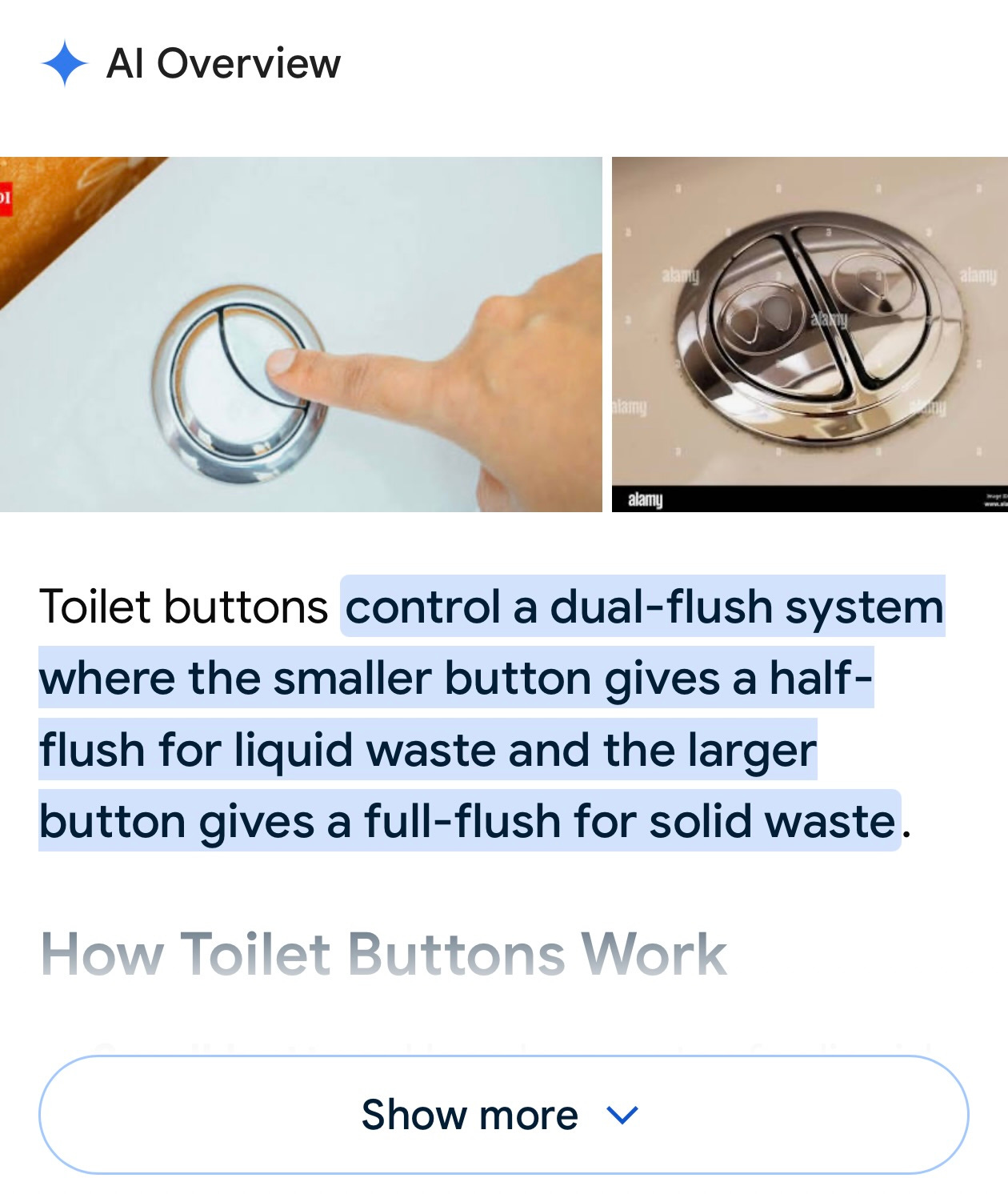
Let’s confirm with Google.
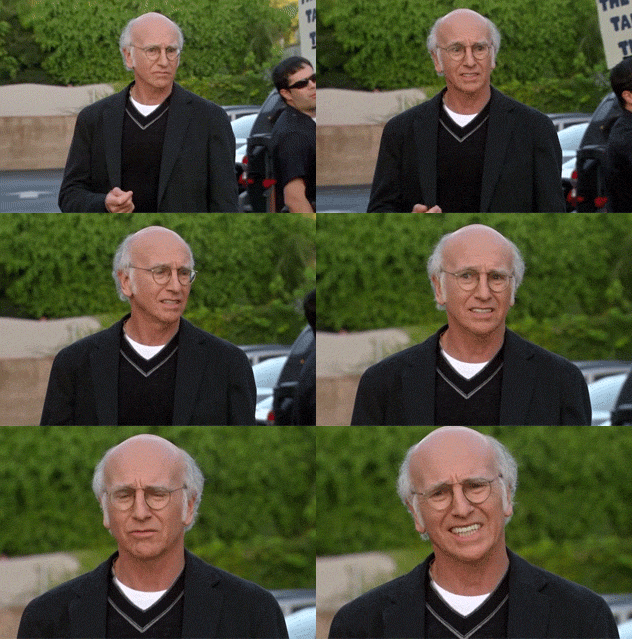
god damn it.
Back to Square One
If this is to believed, then I’ve got it all wrong. But why should I have to do research before I can flush my business away? I need to do homework, before I can operate the toilet? My cat goes in his box and does his thing and covers it, job done. A dog is even less fussy than that, squatting or lifting a leg wherever he may roam. Humans can’t live simple lives with levers on their toilets anymore, we have to solve a riddle first.
I don’t even understand the logic behind these inscrutable signifiers. The bigger button is for more water in a flush? That makes some sense to me. Okay, I’m beginning to get it. Let’s continue browsing the toilets.
Forget it.
During the research I did on my phone as I stood in front of the disgusting business I completed, I learned that the toilet button is meant to, of all things, savewater. The puzzle is not intended to entertain a bored brain made soft by AI overviews, entertain a quiet mind longing for noise, or engender some sense of accomplishment in an empty life desperate for validation. It’s for sustainability. By using less water to flush our leavings, we can each save a little bit of water, a financial and environmental bargain. The quest is not for a sense of deductive accomplishment but for the materiel benefit of preserving our environment. This admirable cause is something I can get behind.
Surely there is no additional puzzle or complication I might encounter when using a toilet. I have found the apex of the Toilet Riddles, the toilet button, and with the benefit of the internet I have deciphered the runes and translated the shapes on this device, and I can-
I have never really had a smell. What I mean is, I maintained a stink-avoidant posture, not a pro-smell position. I defined my personal aroma by avoiding stink, not by making myself smell better.
This was true for the first 48 years of my life. I was happy. I was clean. I moved through life with a blank odor, a whiff of, at most, deodorant and soap.
Until I had an epiphany: There are people in my life who smell good. More than avoiding stink, they surround themselves with pleasant odors. Why can’t I smell good, too?
Previously, I had a very limited exposure to cologne. When confronted by cologne in the wild, it mostly reminded me of the stink of WVU in 1996, frat boy beer farts, sex-starved dorm dudes wearing jewelry, smashed into the PRT. Gold chains and ugly shirts and red solo cups and stale, bottom-shelf beer.
But the people in my life who smelled good defied those bad scent memories. They were mostly women, for some reason, maybe because women are more likely to wear fragrances? That’s pure conjecture. Let’s see what Google says. Okay, yes I am right. According to this research, 71% of women and 29% of men wear perfume.
The origin of my low opinion is irrelevant because I am here, now, with those scent memories and attendant feelings. I still think most of them stink! And yet.
And Yet!
In December of 2025, I discovered that I do not loathe all male scents and in fact there are some fragrances I enjoy quite a lot. A confluence of events and realizations led me to the hallowed halls of websites I had never known existed, like Scent Split and Fragrantica.
The realization I had was this: sometimes somebody around me will be wearing a fragrance that I enjoy so therefore mightn’t I find some that I could wear, too? Maybe I had spent all this time smelling the wrong smells. After all, what’s the difference between fragrances for women and fragrances for men? The distinctions seem arbitrary to me, like blue for boys and pink for girls.
I have enjoyed reading BD McClay and Margaret Welsh‘s fragrance writing — they can pull apart the differences in these smells whereas I just get quaffes. They can write about these eau de perfums with nuance, like a critic writes about things.
Could it be that my limited exposure to fashion or lifestyle or beauty (or whatever this genre is) is not helping me understand how to write about fragrances? Does that limit my enjoyment? Is “fragrances” even the right word? I suppose I could say “perfume” but that’s gendered in American english (not that it matters to me, see below).
You Don’t Need to Know The Lexicon to Understand the Language
I once told a friend that I didn’t really feel like I have a valid opinion on a piece of art because I don’t have the vocabulary or depth of an art admirer. I can’t tell if what I’m looking at is “good,” like in the context of its peers, so to speak. For instance, I know enough (just enough) about painting to know that Thomas Kinkade’s work is cringe and lowbrow despite looking broadly like paintings that are typically considered “good.”
So she told me to not think too deeply about it. What did it make me feel when I looked at it? This first reaction, this aesthetic impression is enough. Do I like it? Then it’s good. Is it technically proficient? That’s another matter.
I am reminded of Jamelle Bouie’s famously negative review of a largely beloved Star Wars movie, Rogue One. I can’t argue with any of his points about the movie’s faults and I also can’t argue that it’s a “good” movie, but I do know that I liked it anyway. All of these things can be true and arguments about whether it’s “good” or not sometimes really do boil down to “I liked this particular piece of art enough to overlook flaws that, to someone else, would be damning.” Whether those faults exist or not is another discussion entirely.
Criticism Helps You Enjoy Things Better
But to be an uncritical, or aesthetic-only appreciator of things is to miss the nuances. I know that I like Rogue One despite the thin development of its hero and the inadequate first act, but I have been watching and reading about movies my whole life. I have a good grasp of the decisions made at different points of the filmmaking process and I have just enough knowledge of the craft to be able to identify what parts of it are effective and why. I also have a pretty good grasp of stories and how they work and why and how their bits come together.
I have an aesthetic impression of many things and I don’t particularly feel the need to increase the depth of my appreciation beyond that first or maybe second feeling. Food, for instance. I am open to eating pretty much anything, but I approach flavors with a broadsword instead of a scalpel. I haven’t learned the distinct flavor notes within the entire flavor profile, so to speak. I don’t even know if that’s the right way to frame it! I don’t really care, either. I like eating. Some yums, some yucks, whatever. Just feed me.
Knowing about writing and stories and craft and constantly thinking about how stories work and how a writer creates tension and emotions and evokes a reaction from the reader helps me become a more discerning enjoyer. My story experience is applicable to lots of kinds of stories, books or stories but movies and tv shows and plays, too. I don’t know which camera lenses are better than others for a given shot, and I can’t tell method acting from any other kind of acting, but I can tell you when the dialogue stinks.
When I see a movie like Nolan’s The Odyssey, I see the ham-handed moral of the story and I think Odysseus is a blunt dufus instead of a wiley trickster, but I also enjoyed the depiction of the Cyclops as a kind of alien creature. The face he makes as he chomps on Odysseus’s men reminds me of the senseless, routine violence of a crab eating its young. It was an upsetting image! I can be aware of the faults of the art yet still enjoy it.
Can I Be a Critical Enjoyer of Fragrances?
Man, I don’t know.
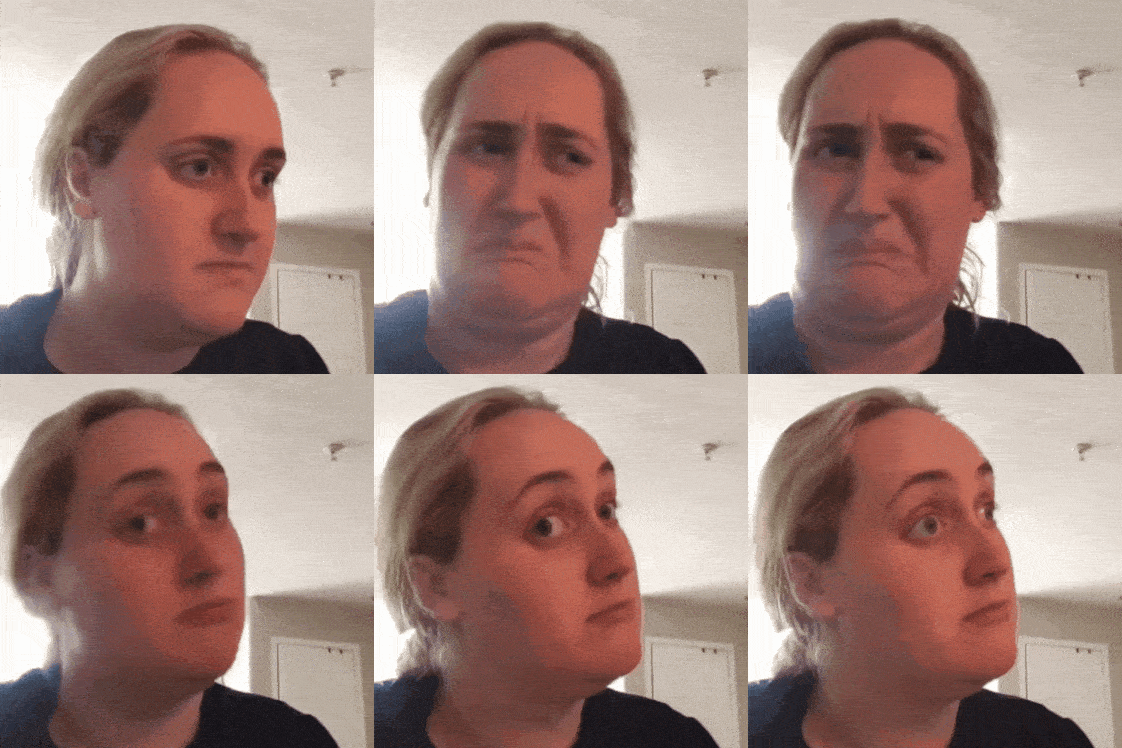
It feels like a lot. I mean a lot a lot. On one level, I’m happy to spray a tincture of liquid on myself, sit with it a while, and do some variation of the Kombucha face.
But I feel like I could be a more discerning fragrance enjoyer. I feel as though perhaps the same enjoyment I wring from stories and books and movies is available to me if I had a fuller vocabulary of words to use to describe it. You know, like a critic.
But first things first. Before I get my hands on the vocabulary of fragrance, I need to try some fragrances on. It’s smelling good that I want, after all. Time to smell some smells.
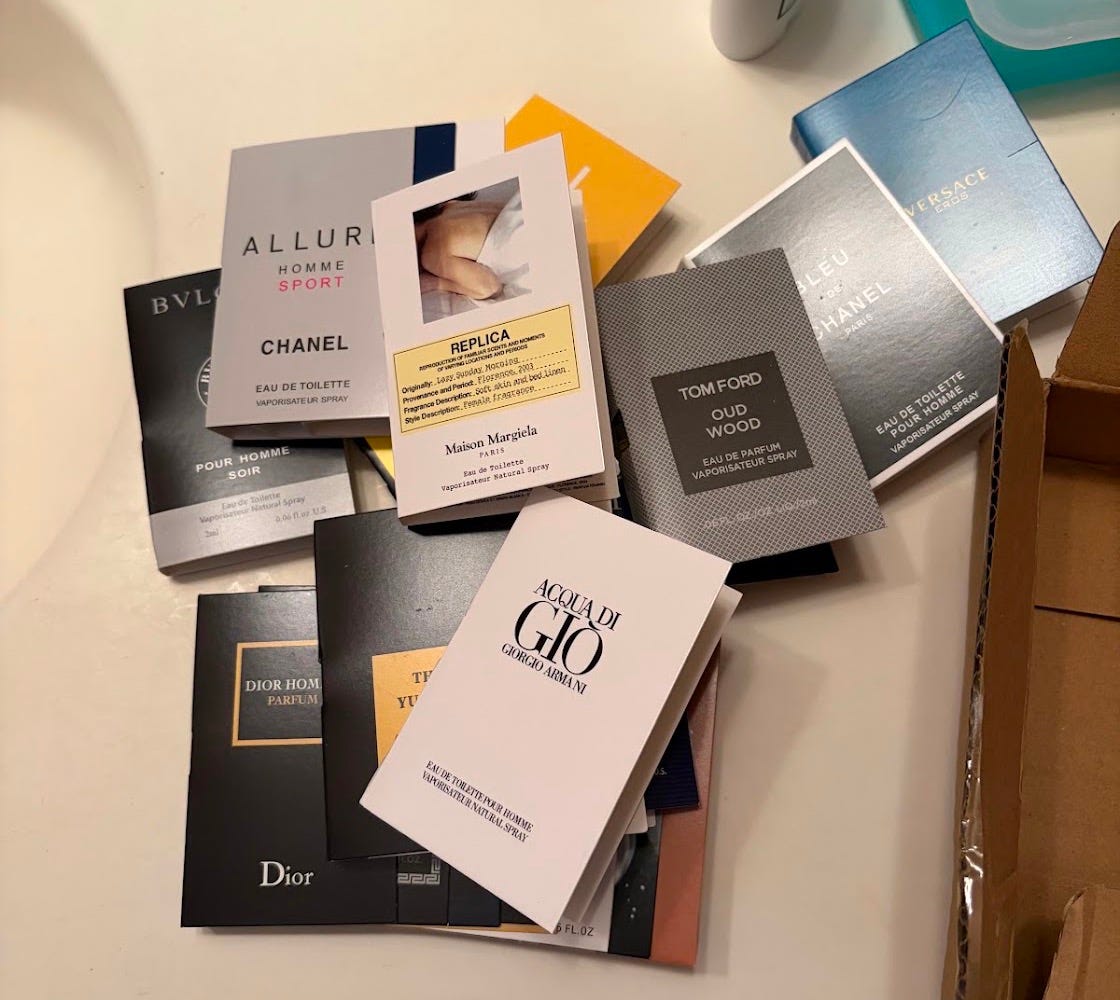
the sins of amazon are many but you can get a ton of cologne samples for like $20
Having decided that I don’t like any colognes many years ago, I had the enviable task of starting completely fresh. I mean fresh-fresh, with zero biases or prejudices and guided by nothing but my nose, a completely clean slate. So I ordered a pack of samplers. A few packs of samplers, actually. The one above had words like “designer” and “high end” in the title. It seemed like a good place to start.
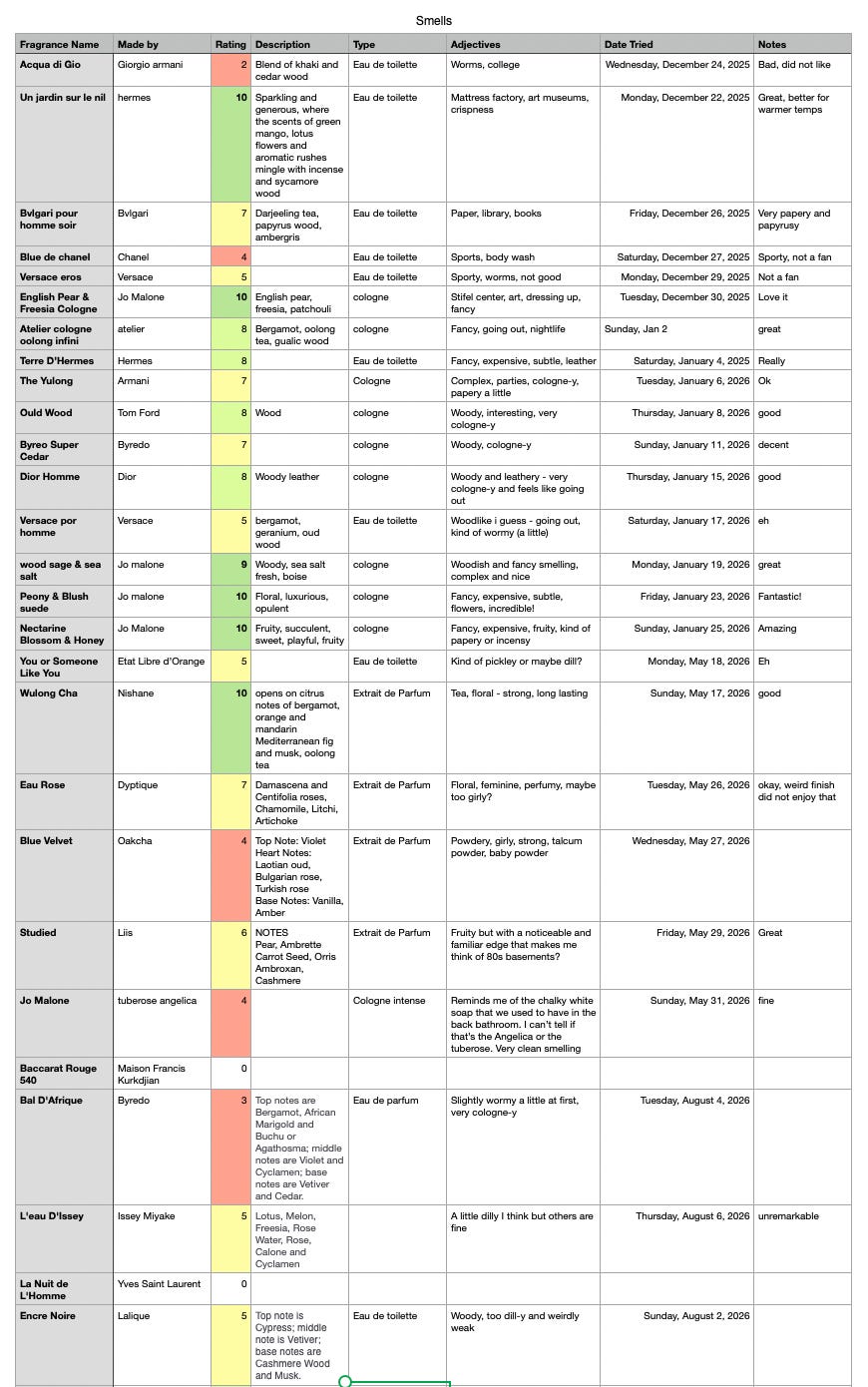
I sprayed a different scent on myself roughly every day for as long as the samples lasted. Pretty long! And I made a spreadsheet to track the ones I liked and the ones I didn’t like.
I was gonna blur this out because I have some idiosyncratic descriptions but who cares
It didn’t start great. As you can see, the first one I tried was gross. If it reminds me of college, then it goes in the bin. There’s another smell I call “wormy” that I don’t have the words to describe beyond “it smells like worms.”
The first one, from Armani, was a no-go. I could have stopped there and reaffirmed my prior opinion that all colognes are bad, but I soldiered on and scored an immediate goal.
The Hermes Un Jardin sur le Nil, a buncha French words that mean “A Garden on the Nile” enchanted me. My notes say “mattress factory” which is an art museum here in Pittsburgh and is where I made a lot of very nice memories. You might also see “stifel” in those notes — I also have a lot of fond memories in and around the Stifel Fine Arts Center in my hometown and those fragrances make me have nice thoughts instead of the depressing stress I feel when I smell those damn worms.
Is this how other people approach fragrances? Am I weirdly tuned into scent memories, or is that a pretty normal thing? I don’t know how else to categorize the smells I encounter except in the context of my experience, and I don’t really have a different context for this new hobby. Is it a hobby? I suppose it is! I have a spreadsheet and everything.
And Then I Met Jo Malone
You can see a pattern if you look closely at my sheet (though I don’t know why you would) — when I encounter a fragrance I like, I take a dive. This is what I do when I come across a new author or genre that I like: I dive deep and dig up as much as I can (or until the next new thing comes along).
One of my samples was English Pear and Freesia by Jo Malone. It made me do the heart-eyes from the emoji. I couldn’t believe it. This was what I was seeking, this was the experience I was digging for, the dragon I was chasing. It hit me in all the right places. Hello, Jo. Enchanté.
I don’t know what she puts in those bottles, but I’m a true blue fan.
Not only has my foray into fragrances introduced me to a whole new vocabulary (like “sillage” which I’m still not sure about), it has given me a team to root for, a house to belong to, a flag to fly. I like to think my experiences are all unique but there are actual stores that sell Jo Malone fragrances and that’s all. It blew my mind, which is a silly thing to say about a perfume store, but what can I say? This is a new experience for me.
Is it Perfume or Cologne? It Might be Both?
I am continuing to experiment with fragrances and try some out. I’m taking the impetus that spurred me to try these smells out and applying it more broadly. If I liked one company’s fragrances, there are probably more out there.
As for the question in the heading, I know that the terms for these fragrances are many and mostly French, but the distinctions between those two is a cultural one. Among the knowledgeable fragrance fans, the difference between those words isn’t who is wearing it but how strong the smell is.
As for myself, I find the unisex fragrances much more preferable over the conventionally gendered ones. The “girly” ones remind me of women, and the “manly” ones remind me of dudes, but I find myself happily squatting in the middle of the aisle, a fragrance moderate. The Jo Malone scents I enjoy all have that in common: they’re unisex.
What’s next? What new smell safari will I embark upon? Who knows? Maybe if you have some ideas for me, you can send me a message. Is there something you know that seems kinda like the stuff I like, maybe you can help me!
Oh Yeah, a Fat Bear Update
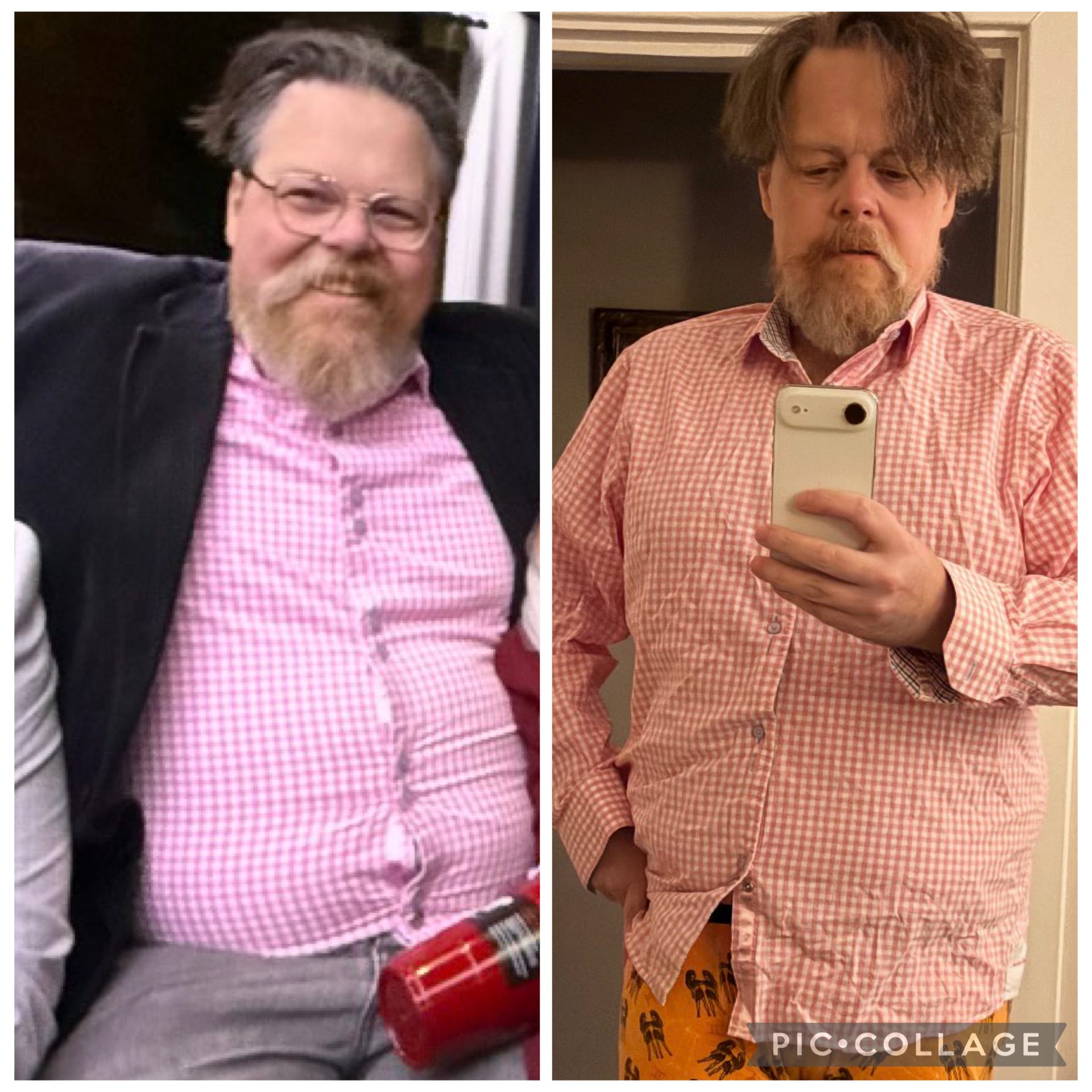
I mentioned when I started becoming interested in fragrances because this is an important fact — it is also when I started taking a GLP-1. It’s beyond the scope of what I’m writing here, but there’s a weird link between those drugs and new interest in pleasant fragrances. And I’ve lost 40 lbs, so the fat bear is a little less fat than he was before. Not bad.
“And the mountains they tried to fall on old Peachy, but he was quite safe because Daniel walked before him. And Daniel never let go of Peachy’s hand and Peachy never let go of Daniel’s head.” – The Man Who Would Be King1
Dan Roemele was my friend. As I discovered in the days since his death, he had lots of friends, more than I knew.
Dan was loud, large, opinionated, and kind, generous, selfless, hard to deal with and easy to talk to. His laugh was large and loud, too, and it came naturally. He laughed a lot and people around him laughed, too.
Dan was extremely private, so private that nobody really knows what his last days were like. From what we have learned, he died peacefully in his sleep. One of us in closer contact with him recalls a series of ailments and small calamities that preceded the terrible quiet that too many of us can recognize, a 21st century silence of unanswered calls and unread texts. Is he busy? In a bad mood? Mad at me? The worst case scenario is unthinkable except in hindsight. Now it feels inevitable.
I Remember the Day I Met Dan
I had just started dating Becky. She was the first girl I ever dated. I moved in with her and she pulled me into her life and I went along happily. She said that her friend was starting a role playing campaign and there was space for us in it.
I have been a TTRPG gamer for most of my life. I specifically loved a system called GURPS and played it a lot with my friends in college. I had tons of sourcebooks and many many hours of game mastering and creating scenarios and worlds for my friends to play characters in. I was almost always the GM of those games and I was excited to find out how other people game mastered.
Dan was living with roommates in a house on Mount Washington. The back of the house was wide open with huge windows overlooking the city below. That house always felt precarious, like it was about to fall into the valley. It creaked and shuddered in the stiff, constant wind.
Dan was tall. He could loom better than anybody I know. He had long hair for the entire time I knew him, but the giant beard came later. He spoke gently and delicately, with a surprising softness. But when it was time for the game, he was on mission and in the lead, confidently at the head of the table with a head full of ideas.
I told him I had a lot of experience playing GURPS and he said “Ugh, I hate GURPS.” I never found out why. He actually played it with me a few times over the years, because he would overlook grudges with a game system if it meant a good time around the table. With Dan, it almost always was that: a good time.
Those first few games were difficult for me! Dan had an adversarial approach to leading a game. While my games tend to be set ups for the players to show off and spend time in the spotlight, Dan was a big believer in consequences. There were no easy answers and no simple solutions.
Dan’s campaigns were like life — if you and your reprobate friends robbed a gangster, then you’d better be ready to spend the rest of the campaign running from him. Our characters never really succeeded at much, but we could take a breather once in a while between calamities that we caused.
The first game I played with Dan was the Wheel of Time RPG — similar to Dungeons and Dragons but set in Robert Jordan’s enormous book series. I hadn’t read the books so the setting was alien to me, but fantasy is fantasy — you can always make a big guy with a big club (or “crub” as Dan would say).
It didn’t matter what character you made, not really — Dan would find a way to stymie their plans, throw mud in their eyes, and make their lives miserable. Most of the time, we made everything worse despite our best attempts. Dan loved giving his players impossible choices and slowly unveiling the next disaster to come out of them.
Star Wars Without Stormtroopers
We played many games with Dan — board games, role playing games, video games — but the games I will most fondly remember are his Star Wars games. The heading of this section will always be my shorthand description of Dan’s Star Wars campaigns.
He set his campaigns in a familiar universe but dropped the characters we made into blisteringly original scenarios that nobody had ever considered for Star Wars, like a space station run by competing groups of criminals, haunted by a medical droid obsessed with experimenting on humans.
Over many years of playing Star Wars campaigns with Dan, I don’t remember our characters ever encountering a stormtrooper. The Empire was an implacable, fascist meatgrinder, not a bunch of bumbling, mustache-twirling Snidely Whiplashes. Our characters never encountered stormtroopers because Dan’s stormtroopers were elite soldiers reserved for important and difficult threats. Our characters were never a threat. They were the smallest of the small timers, barely making a dent and barely surviving.
Dan’s Star Wars games were not about larger-than-life heroes blowing up death stars and fighting with lightsabers. If you ever found a lightsaber, your character wouldn’t know what to do with it and would probably lose a limb. I remember a near total party wipe on a slippery ladder. It was maddening! But it was also so idiosyncratically Dan-specific that it’s impossible not to love it.
When faced with a dilemma or fork in the road during a game, Dan would offer what seemed like sound options. From a different GM, you would think “oh this is what he wants me to do.” Sometimes that was true and it is exactly what Dan wants you do to, but under no circumstances should you do it. We started holding up this sign for the other players when Dan’s suggestions seemed reasonable and one of us seemed about to make a terrible decision.
Dan had a little tic that I will always think about when I think about him. Whenever he was game mastering, and he was about to narrate the next scene of the game, he would pause for a moment to consider what to say, and then make a little throat-clearing noise before unleashing the booming, authoritative declaratives of a dungeon master. I will miss that.
A man of contradictions, he was quiet and reserved in social functions. He hovered at the edges, swaying back and forth on his feet, as far away as possible from the hubbub of a party. He left early if he decided to come at all. At the little celebration of his life last night, we all agreed that he would never have come to it.
He was in his element when he game mastered, like we were seeing the true him. I have only recently learned that I probably wasn’t seeing the true him even then.
The Parable of the Elephant
I’m sure you’ve heard the parable of the blind men and the elephant, the lesson being: you can’t understand something properly if you only ever consider it from a single perspective.
At the celebration of his life, we assembled a picture of our friend Dan from a dozen different perspectives like the blind men in the parable. He revealed one part of himself to some, and another part of himself to others. Maybe everybody is like this, but as we talked and caught up with each other last night, I don’t think any of us really knew Dan. What was the “real Dan?” Only he will ever know, I suppose.
I don’t know if I knew the real Dan, but I know I knew my Dan, and I loved him. He was hard to love sometimes, and stubborn and certain about everything. He was a singular being. He was a bright, blazing light, full of love and overflowing with kindness. Abrasive, yes, but soft. He was always the first to help you move and the last helper to leave.
Sometime in the last few years I had to leave a game early because of some emergency or other, and Dan said “We game tonight in the missing man formation.” It sounds ridiculous and cringe but Dan didn’t care and probably didn’t even notice. It was just the way he talked.
I miss that voice. The world is a colder place without Dan’s warmth in it.
I am sorry that you never got to meet him.
I’m not the only one who shared his memories of Dan Roemele. I’m going to link to them here as I learn about them. I don’t think Dan had an official obituary so these tributes from his found family shall suffice.
Dan had a poster of the cover of this movie on his wall when I first met him. I was astonished that anybody even knew about that movie, one that I had loved since I was a kid. It was the first sign to me that Dan was somebody I was going to like.
When my psychiatrist asks me if I’m having “death thoughts” my answer is always the same: “not in the way you are asking, but yes.”
I’m not suicidal, but death is a constant preoccupation. The intensity increases and decreases as I cycle through the usual peaks and valleys of depression and anxiety. In other words, I’m pretty much always thinking about death (my death, the deaths of my loved ones, the deaths of strangers, the concept of death, life after death, etc.).
Naturally, I’m drawn to art about death and dying.
My sister recommended Hamnet to me, so I read it, and I want to write about it because it affected me greatly in all the best ways that great art does.
Hamnet, a Love Story About Grief
Grief is a kind of universal element that lives in all of us, like the carbon atoms in our bodies. Every human on earth has (or will have) a personal experience with death. New people join our own universes all the time and they all leave eventually, too. They always seem to leave before we’re ready. Nobody in Hamnet’s life was ready for him to go.
We know from the very beginning of this novel that Hamnet will die, so it’s not a spoiler. When it happens, we’re still shocked. The magic trick of this book, and maybe all great historical fiction, is how O’Farrell hides the historicals behind the fictionals.
Hamnet is a Boy and Agnes is his Mother
I can approach Hamnet thematically and say it’s about grief, but that’s not quite accurate. It’s really a book about a person, Agnes, who is a witchy sort of woman living in the middle ages in Stratford, England. Her husband happens to be a playwright we all know but he’s never named and we mostly learn about him as he comes in and out of Agnes’s story.
Agnes is a kind of village shaman, using herbs and other natural things to heal people. The writing borders right on the edge of magical realism, because sometimes it seems like Agnes really can learn about people just by touching their hands in a specific place, and sometimes it seems like her folk remedies actually can rid someone of the plague or fix whatever else is wrong with them.
In the world of the book, she can and she does.
She grows up feeling wrong, out of place, too dark, too tall, too unruly, too opinionated, too silent, too strange.
A Note About Craft
I am a big fan of O’Farrell’s writing. Here’s one of my favorite passages:
WHEN THE TWINS WERE VERY SMALL, PERHAPS AROUND THEIR first birthday, he had turned to his wife and said, Watch, Agnes had lifted her head from her workbench.
He pushed two slivers of apple across the table to them. At exactly the same moment, Hamnet reached out with his right hand and gripped the apple and Judith reached out with her left.
In unison, they raised the apple slices to their lips, Hamnet with his right, Judith with her left.
They put them down, as if with some silent signal between them, at the same moment, then looked at each other, then picked them up again, Judith with her left hand, Hamnet with his right. lis like a mirror, he had said. Or that they are one person split down the middle.
Their two heads uncovered, shining like spun gold.
I have read other reviews that mention how affected the prose is and that makes me wonder if I’m missing something or if they’re seeing something I’m not. However you want to describe Maggie O’Farrell’s writing, I think it’s great and I want to read more of it.1
A Mother’s Grief
You never get over grief. It’s not like a virus or infection that runs its course and goes away. We have to live with it always. It comes and goes.
Hamnet shows us the architecture of the grief in Agnes’s heart after her son dies. One measure of a great story is that it reflects back at you what you can recognize but in ways you never thought of before, or illustrates them in ways you would never have considered. I see myself in Agnes and her anguish.
This passage puts to words an experience we can all relate to: when we think of someone and, for a moment, forget that they’re gone.
She, like all mothers, constantly casts out her thoughts, like fishing lines, towards her children, reminding herself of where they are, what they are doing, how they fare. From habit, while she sits there near the fireplace, some part of her mind is tabulating them and their whereabouts: Judith, upstairs. Susanna, next door. And Hamnet? Her unconscious mind casts, again and again, puzzled by the lack of bite, by the answer she keeps giving it: he is dead, he is gone. And Hamnet? The mind will ask again. At school, at play, out at the river? And Hamnet? And Hamnet? Where is he? Here, she tries to tell herself. Cold and lifeless, on this board, right in front of you. Look, here, see.
It’s not just a book about how Agnes and her family roil and boil in their grief over Hamnet’s death. A good story also has a trajectory, a movement from the state of things in the beginning through some transformational event. That transformation is the heart of drama.
It’s part of the human story, too. We begin a life, even a single day, as one person and events happen that change us forever. Agnes suffers the death of her son and grieves and, in the last chapter, is permanently transformed. I’ll get to that in a minute.
Station Eleven (the series)
I haven’t read the book Station Eleven by Emily St John Mandel. I was so powerfully affected by the series that I don’t want to alter it in my mind by reading the book. I don’t know if that makes any sense. I don’t even like recommending Station Eleven to people because I’m afraid they won’t like it as much as I did, or, perhaps worse, won’t be as affected by it as I was.
The tv show was a profoundly moving experience. I watched it as the last few episodes aired. It was a show that was being made before and during the pandemic and it aired those last episodes just as the lockdowns were ending.
The series is about Kirsten, in both the present day and 20 years after the pandemic that killed most of the world’s population. She is an actor in the Traveling Symphony, which performs music and plays to the communities that have sprung up in the bones of the old world.
It’s post apocalyptic but not in the way you might be used to. One of the things I loved about Station Eleven is how it depicts the end of the world as the beginning of a new one. Most post-apocalypse stories are about how society breaks down and sets people against each other. This does not ring true for me and what I know about people.
What do you see on the news when disasters happen? What do you see when tragedy happens in your own life or in your own community? People don’t scatter and huddle in their basements with guns aimed at the door — they spring into action to help. Look at the aftermath of any disaster, anywhere in the world. The pile of rubble that used to be a hospital is crowded with people digging others out, tending to the injured, comforting their neighbors. If the end of the world happened, I don’t think everybody would immediately leap at the throats of their neighbors.
There are violent people in the post-pan(demic) world of Station Eleven, but they’re fringe crazies, aberrant exceptions. They barely appear in the story at all.
By the end, Station Eleven brings all of the characters we’ve met over the course of 10 episodes and puts them in a post-pandemic, post-apocalyptic production of Hamlet. In acting out the play, our characters reach a kind of mutual understanding of each other and allows them to set aside the traumatic happenstances that led them to fighting and scheming against each other.
Hamnet is Also Hamlet
Factually, William Shakespeare had a son named Hamnet who died of the plague at the age of 11, and a few years later he wrote a play called Hamlet. We also know that Shakespeare made a lot of money and sent most of it back to his family in Stratford. He retired there, too.
In the book, we see a Shakespeare who can’t sit still. He needs to be in the city, performing, creating. Even after the death of his son, he can’t stay with the family. He can’t explain it to Agnes, who is perplexed by his callousness and selfishness. She watches him leave after their son’s death and she understands him even less than she did before.
In the book, Agnes hears that her husband has written a play with the same name as their dead son, and she’s enraged by it. How dare he! She and her brother travel to London expecting to be disgusted.
But that’s not what happens.
She watches the character of Hamlet, who looks and acts just like her son, who has been coached and trained by her husband exactly how the boy stood, or smirked, or walked, or spoke. Her husband plays Hamlet’s father, a ghost.
“Hamlet, here, on this stage, is two people, the young man, alive, and the father, dead. He is both alive and dead. Her husband has brought him back to life, in the only way he can. As the ghost talks, she sees that her husband, in writing this, in taking the role of the ghost, has changed places with his son. He has taken his son’s death and made it his own; he has put himself in death’s clutches, resurrecting the boy in his place. ‘O horrible! O horrible! Most horrible!’ murmurs her husband’s ghoulish voice, recalling the agony of his death.
He has, Agnes sees, done what any father would wish to do, to exchange his child’s suffering for his own, to take his place, to offer himself up in his child’s stead so that the boy might live.”
Agnes experiences her husband’s production as a catharsis, a revelation. Through this performance, she can process the death of their son and see, finally, and in stark relief, the context and shape of her husband’s grief, too. Agnes can move on to the rest of her life with a new understanding of her husband where before she had always struggled to comprehend him. Art transforms.
Shakespeare, Agnes, Kirsten and Jeevan all use performance, as witnesses and as participators, to talk and listen to each other.
The stage allows us to be vulnerable and exposed while also hiding our true selves behind masks and costumes. Words written for us, spoken by characters who bear no relation to ourselves except in our mutual humanity, resonate through time and distance and unite us together and help us, too, to understand each other. This is not just performance but all art. Great art shows us ourselves while it shows us things we’ve never seen.
I gave you a piece of Hamnet to read, so naturally I want to give you a piece of Station Eleven to watch.
This has small spoilers, but it’s from the second episode so you’re not missing much context. Jeevan, the man taping up the vent, is introduced to us as a guy watching a production of King Lear who sees a famous actor on stage have a medical event and instinctively runs on stage to help him. Kirsten is a child actor in the same production who gets lost in the chaos after this event and the simultaneous outbreak of a world-ending flu pandemic. They take refuge in Jeevan’s brother’s apartment.
Kirsten is also the adult woman in a production of Hamlet that does not fully unfold fully until the end of the show (but you can see it hopscotches through time).
Great Art Transforms Us
As we watch a play or performance, we experience the text of the songs being played or the lines of dialogue being spoken and they allow us to reflect on our own lives and feelings.
We see a wrathful Iago scheme and plot against his commander and remember the times where we, too, were passed over for a promotion. That other guy didn’t deserve it, but we do! When we see Othello, twisted and contorted into seeing an unfaithful wife, we can think of the times we lost our faith in our own friends or lovers. When Othello snaps and strangles his dearest love, we can all remember the times we treated someone badly because of our own anger or resentment.
Hamnet and Lincoln in the Bardo
The obvious accompaniment to this book, or maybe another book in a reading list, would be Lincoln in the Bardo by George Saunders. It’s a different kind of book in lots of ways — it takes place in the Bardo, or the space between life and the afterlife, and our characters are all unquiet ghosts in a cemetery. Stylistically they couldn’t be more different, as it’s all told in a shifting, choral sort of epistolatory first person. These ghosts witness Abraham Lincoln come to visit the temporary tomb of his son who has, like Hamnet, died young from a disease.
Lincoln’s grief is legendary and known to us. He is said to have held his boy’s body in this temporary resting place.
All three of these pieces — Hamnet, Station Eleven, and Lincoln in the Bardo, are in conversation with each other, at least in my mind. They are certainly in conversation with each other to me. Interestingly, Hamnet and Station Eleven kind of came out around the same time, so they weren’t in clear communication with each other.
You don’t have to squint to see it is also in conversation with The Pitt, which also hops back in time to the worst of the COVID-19 pandemic. It, too, is kind of about grief and moving on when everybody seems to be dying around you.
We’re so powerless against death. We are always fighting it, writing about it, making shows and art about it, trying to understand it.
My pitch for a thrilling Star Wars show after Andor
The rebels won, but the dirty work isn’t done.
Added 9/13/25: I’m revisiting this for the algorithms because the conversation about Andor has not stopped. This is my vision for a series that would take place after Andor, but you can also see this as Andor Season 3. This article goes over some of it — Tony Gilroy gave an interview where they asked him about a fan’s idea for Andor Season 3. That idea is similar to mine, but it frees Daedra from prison and makes her a Hannibal Lecter type of character as she gets revenge. I don’t like that because I think it’s much more interesting to put her where I have (as a double agent against both the Empire and the Republic).
This is a long post of very niche, nerdy fan fiction. I’ll include a little overview of my relationship to fan fiction and related topics at the bottom. Until then, enjoy my pitch.
Some art feels like it was made specifically for us and sometimes that very art stirs us to make our own. I have had this idea rattling around in me for quite a while, probably some time after Rogue One came out. I want more stories like the ones Andor gave us, so I wrote them.
Anyway, I’ll start with the pitch:
Title: Star Wars:Rogue Company
Logline: A year after the fall of the Empire, A team of rebels hunt down the worst Imperial war criminals against the backdrop of a burgeoning New Republic.
Tone: Andor meets the movie Munich
Synopsis: The long galactic nightmare is over. The Emperor is dead, the Imperial Remnant has been defeated and scattered to the Outer Rim. The New Republic is building what it can from the wreckage of what came before. While the leaders of the Rebellion pick up the pieces of what’s left of the Imperial government, a small team of operators, spies, soldiers and scoundrels work in the shadows of the new dawn to hunt down the worst of the Empire. From the disgraced Senators who collaborated with the evil Empire to the generals at the tip of the Imperial spear, Rogue Company brings them to justice.
Main Characters:
Kleya Marki. The main protagonist. She worked for many years with Luthen Rael to chip away at the Empire and, ultimately, create the circumstances that allowed the Rebel Alliance to exist. In the days of the Empire, bombings and assassinations were the norm, but the new bosses want her to stay on the straight and narrow.
Arin Mosch. The other main protagonist. He’s a true believer in the New Republic and its lofty ideals. He’s the moral counterpoint to Kleya’s ends-justify-the-means methods. He is the scion who went to war while his siblings managed the family business. He frequently clashes with Kleya.
General Alexsandr Kallus. A former ISB agent who secretly fed information to the Rebels under the name Fulcrum and defected to the Rebellion. He is tasked with developing a New Republic espionage and counter-espionage division while also staying true to its ideals. He is Rogue Company’s commandant, the guy who gives the orders and sets up missions.
Dedra Mera. Imperial triple agent. Dedra survived the fall of the Empire only to find herself among a small Imperial Remnant after a prison break staged by Rebellion operatives. The Rebels believe that she is their secret but she is actually feeding them false information. She works against both the Imperial Remnant and the New Republic in service of her mysterious new master. She walks the knife’s edge at all times and even she doesn’t know where her true loyalties lie anymore.
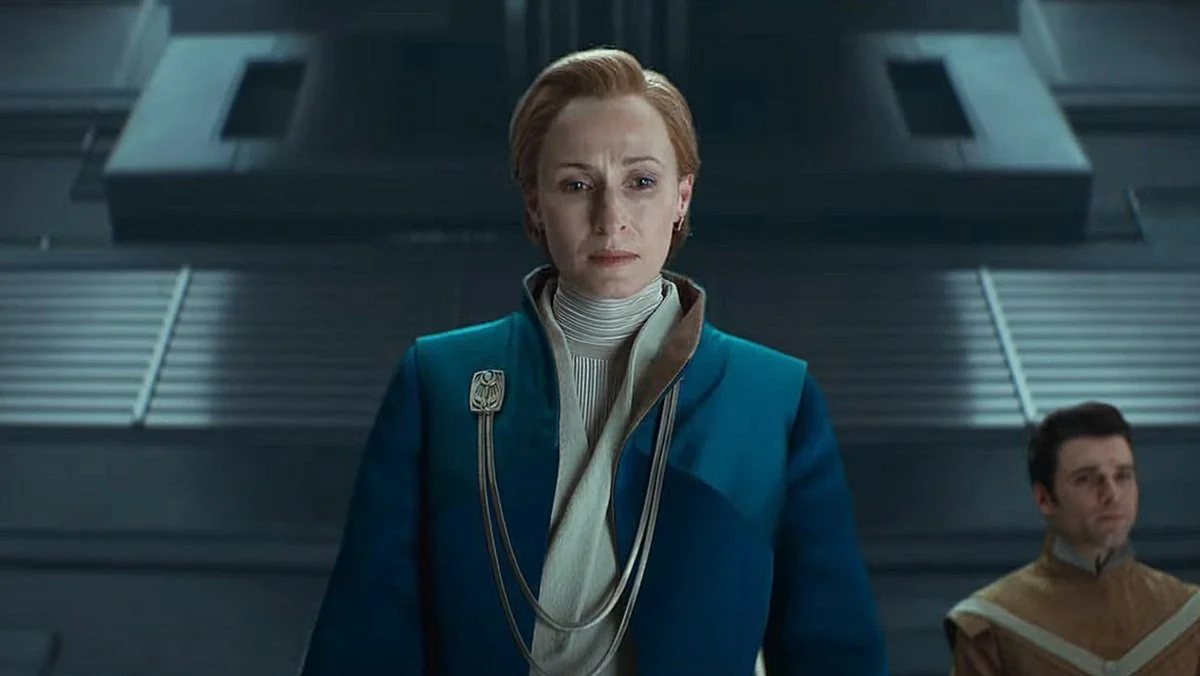
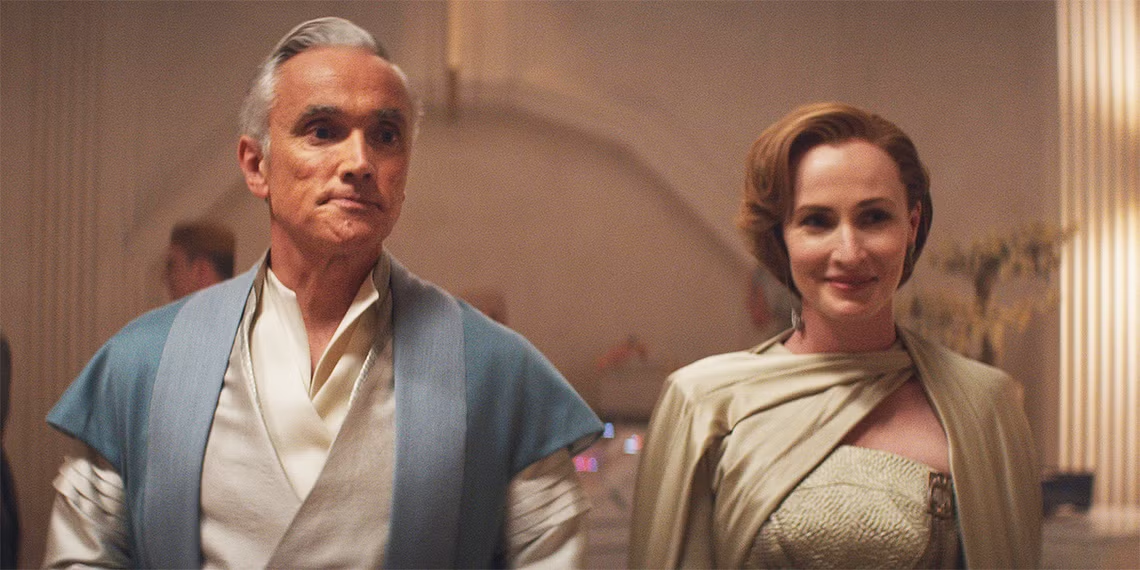
Mon Mothma. The leader of the New Republic. In addition to the constant challenges of creating a new government, she has to deal with the old, unsettled scores of her life as a Senator, appease the many factions fighting for favor, and prevent the Imperial Remnant from filling the vacuums that the New Republic can’t fill themselves. On top of that, there’s the matter of all the promises, compromises and favors she made in the service of the greater good and what happens when those porgs come home to roost.
Senator Tamril Yoost. Senator from Kuat. Yoost is the main antagonist to Mon Mothma, representing the planet most sympathetic to the Imperial Remnant. Yoost is outwardly supportive of the New Republic as it takes shape but unabashedly critical of the Rebel Alliance’s methods during the war. Maintains the lie that the Jedi are dangerous and blames Darth Vader for the Emperor’s radicalization.
Chief Advocate Marl Fetter. A harried and experienced attorney in the Coruscant justice system, Fetter defended Rebel criminals against Imperial crackdowns, constant authoritarian overreach, mercurial shifts in enforcement, and capricious, inscrutable corruption, all while deftly avoiding reprisal. He was a natural choice to head the new government’s criminal justice reforms and the prosecution of the Imperials, but he’s used to being on the other side of the courtroom.
Neska Pujar. Ambitious young journalist with something to prove and new hire at the Coruscant News Network. Neska has only ever known the Empire and lived a hard life in the lower floors of Coruscant. She has fought hard to get to where she is, and was just assigned to the Reclamation Desk where she does little more than rewrite official reports from the garbage and sanitation departments. She stumbles upon information that suggests things are not what they seem in the new government.
Supporting Characters
Moff Kobb Sobelle. Sobelle was the Moff in charge of the Kuat sector during the Empire. He is most definitely still in charge of Kuat, albeit unofficially, and maintains his luxurious lifestyle. He keeps a reprogrammed Operation Cinder messenger droid as a toy. His hedonistic lifestyle hides his true ambition: rebuild the Empire with himself as the Emperor.
Hosan Maye. A low level Imperial manager who only knew the Empire as his employer, blissfully unaware of the crimes and atrocities and nearly every aspect of the Galactic Civil War. The New Republic is just the new boss to him, and he dutifully continues his work overseeing Sector 7345 in the Coruscant Sanitation Department.
Episode 1: Long Live the Empire
An angry Kallus storms out of a meeting with the New Republic military. Kallus has presented irrefutable evidence that Kuat is harboring an Imperial Moff who oversaw and facilitated multiple war crimes. The military council refuses to act, preferring a diplomatic solution that has so far gone nowhere.
Kallus finds Kleya Marki who has been quietly supporting rebellion elements in Imperial Remnant sectors. He convinces her to come back into the field and undertake a secret, unofficial mission to bring Moff Sobelle to justice.
Mon Mothma presides over her own contentious meeting, though hers is with representatives of the Rebel Alliance and members of the Coruscant delegation. They argue about how much power former Imperials should have and what concessions are necessary in order to keep the capital planet operating smoothly. One of those is the head of Coruscant Reclamations, who returns to his own department with a chip on his shoulder.
He is forced to demote one of his best administrators, a mid level Manager named Hosan Maye, a former Imperial who oversaw multiple departments of garbage sorters, including a family of Ugnaughts. They’re fired by their uncaring, ambitious new manager. One of those Ugnaughts kept an old holo diary of a Clone Wars commander turned Imperial who suspected, and gathered evidence, that Darth Vader was actually Republic hero Anakin Skywalker. This Ugnaught quietly gives Maye this recording as a parting gift.
This is a pretty great pitch, right? Maybe one of your Hollywood friends would like to read it haha lol jk or unless…?
I stopped at one episode because you get the idea.
The plot of the show is structured similarly to Andor. The main story centers on Rogue Company and their secret missions to bring war criminals to justice. That sets the scaffold on which the whole show is built and gives us our two leads, Kleya and Arin.
Their first mission, likely over the course of a few episodes (following Andor’s 3-episode arc structure), would be to extract Sobelle. Further adventures, quests, or missions could include more extractions (and a few lively debates about assassinations), heists, and general shenanigans against the Imperial Remnant. We could even venture into the dark underbelly of the galaxy — we don’t see it much in Andor, but the Hutts and the Pykes are two among many criminal organizations still active and still very much a threat to peace.
The possibilities for continuing adventures are endless, but here are a few of my ownarc ideas:
Life During Wartime. A deep cover specialist with cyber mods that allow them to change identities goes silent. Their final message warned of an impending disaster and hinted at another secret super weapon. Is this a paranoid break with reality or something much worse?
Uneasy Ghosts. Tay Kolma was a loose end to Luthen and Kleya but he wasn’t just a man in the wrong place at the wrong time: he was a connected and influential member of the Coruscant elite. Tay’s widow, penniless and destitute, comes to the Coruscant NewsNet with a wild accusation: her husband was murdered on orders from Mon Mothma herself.
Too Many Masters. The hits keep coming for Dedra — her Republic controller demands something they can use or they’ll cut her loose. Her leads on Republic secrets have dried up and her Imperial commanders are losing patience. One night, a stranger visits her in the dead of night with an offer: for the low, low price of an undefined favor some time in the future, they will give her exactly what she needs to satisfy both. What could possibly go wrong?
Sympathy for the Devil. The return of the Republic means the return of the rule of law and the pursuit of justice. Marl Fetter has become a steady hand in the chaos, balancing a need for justice against cries for revenge from the many victims of Imperial rule. His dedication to truth and justice is tested when Rogue Company brings in a famous war criminal who might not be who he claims to be. The victims want blood, and there are lots of people in the New Republic who don’t care that he might not be the man responsible — they need a win. Can Fetter knowingly sacrifice an innocent man on the altar of freedom if it’s for the greater good?
This central conceit and set point of view on Rogue Company could be easily modified a little bit to make it a procedural, with a Villain of the Week structure. I don’t think that’s as interesting as my version, which builds on Andor’s depth and scale.
Character Dynamics
Just like Andor, Rogue Company lives and dies by its characters. A proper Season 3 of Andor should pull some characters over — Kleya feels like a natural co-lead. The character of Arin is meant to be a foil to her. He’s a true believer in the values of the New Republic. He’s been submerged in the rhetoric for so long that the whole struggle must seem pretty black and white. Kleya long ago gave herself up to the gray. Throughout the course of the show, they will bring each other a little closer to their side and maybe meet somewhere in the middle (at least in some cases). While Arin is due for a rude awakening, Kleya could use a little light in her darkness.
Again, like Andor, we also follow other stories. Mon Mothma has an unenviable job in front of her. She has to help make a new government that’s better than the old one, rebuild the Senate, deal with the last 20 years of Imperial authority, rebuild the bridges she burned when she joined the Rebels, and try to pay all the debts she accrued and return the favors she promised while she led the Rebel Alliance to victory. A lot — and I mean a LOT — of people are going to want to take credit for what the Rebels accomplished. She’s their main target.
Senator Yoost is a villain with a lot of juicy possibilities. He’s been around a long time and has too high a profile to be removed. In private, he changes his mask depending on who he’s talking to — in his meetings with Mon Mothma and other rebels, he’s a sympathetic fellow traveler who misses the easy choices of the Old Republic but grudgingly must do what his constituents demand. To the former Imperials still floating around Coruscant, he’s just playing nice with the New Republic while helping funnel aid to the Imperial Remnant. The New Republic has “may the force be with you.” The Imperial Remnant has “Long live the Emperor.” To the public, he’s a fiery critic of the new government and is quick to remind everyone of how great things were when the Emperor was in charge.
We’ve never seen criminal justice in Star Wars. The arrest of Andor and his subsequent imprisonment are the closest we’ve seen. There are some in the deep, pre-Disney lore, but I bring it to the forefront. If you’re bringing war criminals in for justice, what does that justice look like? My pitch for Andor Season 3 introduces the tantalizing possibilities for Star Wars courtroom drama and lets us explore what this victory really means for the good guys. How good are they, really? Let’s find out!
More on the Supporting Characters
I didn’t fill out more of the Company itself, which could include a bunch of really interesting side characters pulled from the Star Wars galaxy — maybe a refugee from Ghorman (like Magva Yarro), a fan favorite like Migs Mayfield, a spunky droid like C1-10P (Chopper), etc. I’d love to see some diversity, of course, both in the human contingent (lest we forget that Rogue One had zero white guys in the main cast) and the nonhuman one.
The Big Secret
The Death Star looms over Andor and Rogue One. That secret is the engine behind a lot of what we see eventually play out, especially in the second season. I propose a similar secret behind the action of Rogue Company: the true identity of Darth Vader.
Behind the immense struggle between an authoritarian Empire and the ragtag Rebels is a religious dispute: Emperor Palpatine is a practitioner of an ancient religion who wiped out his generational enemies, the Jedi, as part of his rise to power. To this end, Palpatine pumped the galaxy full of anti-Jedi propaganda for decades.
Anybody who is remotely pro-Empire is going to lean into that propaganda to sow discord against the New Republic, which has an actual Jedi at the center of its two greatest victories: the destruction of the Death Star and the death of the Emperor.
I can easily see the Imperial survivors blaming Darth Vader for all the bad things that happened, including the evils of the Empire itself. All the galaxy knows is that Palpatine started the Empire after the Jedi tried to assassinate him. Simultaneous to this was the appearance of Darth Vader, in his spooky black armor, at the Emperor’s side. Nobody knew who he was or where he came from. The obvious move for the Imperial sympathizers is to blame Vader for everything, including Palpatine’s sudden turn to authoritarianism. Palpatine would approve.
Imagine all that discord circulating in the galaxy and then it comes out that evil, manipulative Darth Vader was all along Anakin Skywalker, the Jedi hero. Palpatine was right: the Jedi are evil schemers and their deaths were all faked by the Jedi themselves. They have secretly been in power this whole time, using their mind powers to twist the Emperor into their servant. That’s bad news for the New Republic! Especially since their big hero was Anakin Skywalker’s son. Imagine if these same people found out who Darth Vader’s daughter was.
Nobody really knows what happened in that throne room during the Battle of Endor. All anybody knows is that Luke Skywalker, a known Jedi, went in with Darth Vader and the Emperor and only Luke came back out. Those Imperial sympathizers would be absolutely frothing to use that against their political enemies. If they knew that beloved Rebel hero and survivor of the Alderaanian genocide, Leia Organa, was Darth Vader’s actual daughter in addition to Luke Skywalker’s sister, and that Darth Vader was also the Jedi hero Anakin Skywalker, I imagine the outcry would be immense. Or, at the very least, the pro-Empire Senators and other leaders could use that to destroy the reputations of the people the galaxy is supposed to trust with the new government.
If all that is true, what other secrets are the Rebels covering up? How can the galaxy trust them at all?
This naturally leads to the third storyline: the reporter.
Journalism in Star Wars
Just like criminal justice, we’ve never really seen what journalism looks like in Star Wars. I’d love to see a hungry, young reporter find out who Darth Vader really was and what lengths the New Republic would go to keep that news from leaking out. We could trace her investigation of his real identity and, through that, explore parts of the galaxy we’ve never seen before.
I imagine Neska, listless and annoyed by the reality of working in the big city, absent-mindedly flicks on the holorecording given to her by the harried, now unemployed former sanitation worker. In this recording, a low-level Imperial officer recounts his theory that evil Imperial scapegoat Darth Vader is actually Anakin Skywalker, the hero of the Clone Wars. She watches this recording, realizing that it might be true, while on the screen behind her, Senator Yoost blames Darth Vader for the latest atrocity to come to light. In this moment, at the end of Episode 1, we set the stakes.
The Canon Question
According to the internet, the true identity of Darth Vader was not revealed to the galaxy until shortly before the sequel era, in a book called Star Wars Bloodline. That would be decades after Rogue Company, so my idea clears the canon issue (I find most questions of canon to be tedious and irrelevant to good storytelling, which should always be the primary aim, but I concede it here).
What Happened to Dedra?
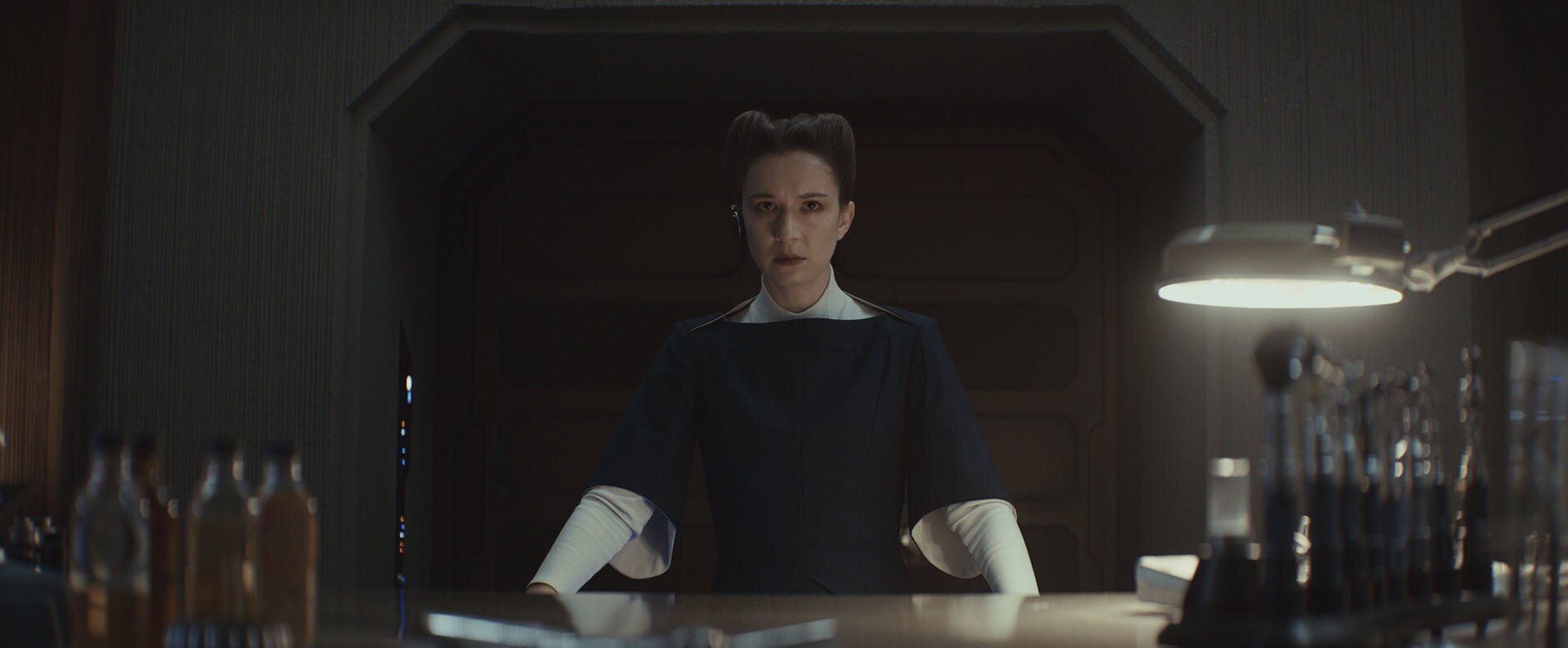
I couldn’t let Dedra die in prison so I would put her back in action for this story, too. She’s on the run and in more peril now. I have her working for the Imperial Remnant but owing her life to the Rebels and serving an additional third master. It seems obvious that this master would be Snoke or a First Order predecessor of some kind, but I left it ambiguous. Dedra is fascinating and I love Denise Gough’s performance. But I also don’t want to make her a hero — she’s a very banal monster but a monster nonetheless.
Her life is an unrelenting nightmare of imminent discovery. The model for this storyline for me is Baltar in the 2003 Battlestar Galactica. I want to see what lengths Dedra would go to in order to protect herself.
The Ghosts of the Future
Looming over any story after the Return of the Jedi is the unavoidable certainty of things like the return of the Empire as the First Order and the return of the Emperor as, well, the Emperor. It gives me some cover for this story, though, because I don’t have to pretend that the New Republic is going to be a return to the thousands of years of peace that preceded the Clone Wars — they’re going to fail, at least for a little while.
Continuing Qualities of Andor
Some aspects of Andor that I want to continue and are important ingredients to what I would call Andor-Like Star Wars storytelling.
no big characters. I don’t want to see any of the famous faces we all know and love. They’re superstars in the Star Wars universe, too. Luke Skywalker, Princess Leia, Han Solo, Lando Calrissian — they are too big for this story.
no Jedi. The force is mysterious and misunderstood, at best.
no easy answers.
Threading the Needle
I don’t want the thesis of Rogue Company to be: “you have to kill all the Imperials just to be sure they don’t come back” nor do I want it to be “you have to be merciful in victory and treat your enemies better than they treat you” despite my own complicated feelings on these issues. I see this show as a way to tell some really juicy, complicated stories in the giant universe of Star Wars and Andor is a beautiful door into those stories. As all fan fiction, I’m just building on what came before me.
Star Wars is about good guys doing good things and bad guys doing evil things and Andor, and Rogue Company, let us look at the shadows between light and dark. Even so, I would want to make sure that light stays bright. It’s important that even as we have fun on the margins of the story, we acknowledge that the story of Star Wars is a victory of good vs. evil. Let’s not lose sight of that.
Final Notes
Like I said, this is fan fiction. I don’t expect an actual sequel to Andor, nor do I envision this as an actual Andor season 3. Getting this whole thing out of my head and into the universe is my only aim. I also welcome any comments or (nice) criticisms.
I posted this to the Andor subreddit but without this last bit because nobody there wants to read about my history with fan fiction.
Anyway, a lot of talk around writerly folks (or maybe creative folks in general) floats around the idea of a “flow state” or the trance-like act of work/creation that we are all trying to access or engender in ourselves.
For a creative writer in the flow state, the words come out as if some greater power is dictating them. Accessing the flow state means tuning our radios to that frequency and transcribing what we hear. It’s the closest I have managed to get, personally, to what I would call a spiritual experience, or a feeling that powers bigger than me are using my brain and my fingers in service of something else.1
The exact nature of this flow state is one of great interest to me and I’ve been collecting data since I read The Artist’s Way (this data mostly amounts to things written and said by famous creatives like Tom Waits and Bob Dylan). The nature or origin of the flow state is probably just some combination of body and brain chemistry that strikes like flint to steel, but it sure feels like, well, the hand of god. Or maybe the hand of “a” god. It’s fun to think about anyway.
I mention the flow state because my longest encounter with it was many years ago, in the back yard of my future in-laws house, where I sat at a picnic table and smoked dozens of cigarettes while hand-writing a script for the first (pilot) episode of a Star Trek show. My show took place a hundred years or so after Picard and company and would form the basis of my first (and only finished) novel (that has nothing whatsoever to do with Star Trek or Star Wars). I couldn’t stop writing that fan script until it was finished, and it came out of me so forcefully.
I had a similar, but smaller-scale, experience with this. I suspect the restrictions of an established story with its own rules is empowering to me, like when you pinch a garden hose. I have spent a lot of idle hours in my life imagining what my own Star Wars stories would be and what I think are interesting directions to take the stories we’ve seen.
Fan Fiction is Great
This would have been impossible to convince me of 20 years ago2, but I am completely in favor of fan fiction as a viable and worthy way to spend our creative energies. I find the ability to create so tenuous and the motivation so often elusive that creation itself, and creative writing specifically, is a sacred and beautiful act, even when (or maybe even especially when) it’s created by a new writer. It’s true that writing fan fiction leads writers to explore their own creations, but that’s just a nice bonus feature. Fan fiction itself is full of wonderful stories and I encourage you to head over to AO3 to find something that rings your bell. I didn’t post this there because it’s not my community and I don’t want to parachute into someone else’s fun corner of the internet for my own gratification.
Gratification is an interesting word. Is that why we write? I would argue that we only write what we want somebody to read, but that’s not always true. Writing something is its own end and requires no purpose.
Thanks for reading Middlebrow! Subscribe for free to receive new posts and support my work.
note that this does not mean I think my Star Wars fan fiction is dictated from God in order to fulfill some purpose, merely that the act of creation is good and pure and primordial irrespective of its point
Every generation gets their own prestige medical drama. I end up watching a lot of them despite my squeamishness. I’m not ashamed to admit that I close my eyes when Dr. Bangs on The Pitt takes a scalpel to a teenager’s eye socket.
I had a couple of brain surgeries a few years ago. The first surgery was just to put a shunt in my head. The second surgery was the Big One. They popped open the back of my skull, plucked out a little tumor, and stitched me back up.
After the surgery was complete, the surgeon told my family about a moment that happened during the operation. As I sat, insensate, in a supine position with the back of my head pealed open, he touched the surface of my brain with his scalpel. My heart stopped. When he removed the scalpel, my heart resumed beating. He did it again, for some reason, and my heart stopped again.
This was, apparently, hilarious.
The Pitt is a Pit But it’s Also a Pitt
The Pitt is a great name for this show. The title refers to the cute nickname the people of Pittsburgh Regional Hospital have for the emergency department. This is because it’s kind of pit-like but also because it takes place in Pittsburgh (which is why they spell it with two Ts).
There are references to Pittsburgh peppered throughout the show and there were only a few little moments that hit my ear wrong (as a 20+ year Pittsburgh resident). For instance, they eat Primanti Bros, but without the requisite “I hate Primate Bros” comment from an aggrieved foodie. My brother Rob observed in the family Discord that they call Pittsburgh’s light rail “the subway” which is a sweeping and grandiose word for what we actually have (we call it “the T” and most people who live here have never ridden it). They drink Iron City and there’s a derisive reference to Philadelphia, so that’s pretty good.
While they don’t always get all the little facts right, they do get one thing right: what it feels like.
The show takes place in the late summer, around the time of a fictional music festival. I read this interview with the producer, John Wells, who went to CMU.
“We shot in early September and there’s that wonderful, muggy, warm, late-summer, early-fall feeling that we wanted to get in,” Wells said. “The way the air feels and the way in which we shot it, we worked hard to get that into those scenes when we were outside, to get that feeling that there’s a heaviness of the air.”
Wells said the crew spent time discussing how to capture the feeling with a camera “and how we were going to move at a certain pace in a way to try and get across that feeling. It’s hard to describe in any kind of specifics. It’s just the way the city feels.” – PPG
He’s so right! The city does feel like that and they captured it so well that I can forgive the tiny little bits that didn’t hit right. Notes for next season: gimme at least 1 yinzer. It’s not Pittsburgh without one! I wonder if Jon Daly is available.
Each episode of The Pitt is an hour of a single day shift in the Emergency Department. There is a palpable dedication to realism1. There are no cartoonish villains or perfect heroes or outrageous scenarios. I really enjoy the tightness of the writing and the economy of story.2
This show also made me miss being in the hospital. I know, I know, but hear me out. When I was in the hospital for those surgeries I didn’t have to worry about anything. The hospital is a building full of people who want to heal you and send you home. They bring you food three times a day. They don’t want anything bad to happen to you. If something really bad happens to your body they will try to fix it.
Out here in the world, anything could happen and I have to find my own meals. Terrible!
The Pitt is a medical drama, but there’s another genre it belongs to: the unfortunately-named “competence porn.”3
I like watching really smart people do smart things. I like to see problems solved and lives saved by skilled professionals.
As I thought about the thrill of watching competent people I started to realize that this is something a lot of my favorites movies and stories have in common. I also suspect this is one of the reasons why people love sports? Maybe!
Great Examples of Competency as a Genre
The movie Sneakers is about a misfit red team who stumbles onto a device that can break any cryptographic code. They use it better than the guy who invented it, because they’re more competent than everybody else.
The book/movie The Hunt for Red October is about a lowly CIA analyst who figures out how a disgruntled submarine captain is going to arrange his own defection while also delivering a secret prototype into American hands.
The show Slow Horses is about competent (and occasionally incompetent) spies manage to figure things out before anybody else. More competent spies can be found on The Agency and Counterpart.
I love it when smart, capable, people solve problems because they’re smart and capable. It’s thrilling! That probably explains why it’s so common in the thriller genre lol
Entering Into the Chaos of Another
The competency is nice, but I don’t think I would enjoy a show about auto mechanics. The urgency and enormous stakes of medicine make it fertile ground for drama (which is why we get so many medical dramas).
I worked for Carlow University for a few years. Carlow was founded by the Sisters of Mercy, Catholic nuns whose devotion to helping people is summed up nicely by this quote by John Keenan:
“Mercy is the willingness to enter into the chaos of another.”
People who work in emergency rooms leap into the chaos of the acutely sick and suffering. They heal and fix and work to save people and join them on the worst days of their lives. The Pitt is fiction but it vibrates with emotional truth. I can’t tell you if it’s factually accurate, but it understands big feelings pretty well. I know a lot about those.
Grief > Joy > Grief; Repeat
In the first episode of the show, elder attending physician Dr Robby gives a med student some advice about how to deal with the constant seesaw of joy into grief and then joy again in emergency medicine.
During a chaotic crisis, Dr Robby, who has shouldered the burdens of these feelings both in himself and in his staff and patients, and the weight of the billion little decisions they make that can unravel into terrible consequences or bloom into ecstatic relief, breaks down, finally, huddled in the pediatric care room. For him, and for us, the suffering is just too great, as his past and his present collide and collapse, a staggering overload that drops him to the floor. We can’t take anymore and neither can he.
The med student he advised finds him and, not knowing what else to do, joins him. Robby tells him to get up and get moving. But he’s saying this as he, himself, can’t.
There’s no monologue at the right moment that breaks the spell. They just get up and keep going. They’re not cured or refreshed, they just continue. All they can do is continue. They open the door and go back into the chaos of the dead and dying.4
They continue on, and the crisis winds down as the day ends. We follow the doctors out of the building, through the waiting room that’s already full again.
But before that, the student and Dr Robby reconnect for a minute. The med student repeats back the advice Robby gave him earlier, and tells him he knows the prayer that Robby had been repeating, in biblical english rather than Robby’s talmudic Hebrew.
The tension from the crisis has abated but not with a narratively easy or convenient explosive release. We do get our release, but this is it: a quiet moment between mentor and student. The story closes its long loop from beginning to end, the wise elder has imparted his wisdom and the young student has metabolized the advice into something greater for both of them.
Robby’s advice is the thesis of the show: you can’t help people on the worst days of their lives and not feel the joy and the grief as if it’s your own — the best you can do is find a balance. The only way out is through, unfortunately.
These Are Spoilers
The last few episodes of the show take place during a mass casualty event. There’s a shooting at the music festival and the Pitt is the closest hospital to the disaster, so they get the worst of it.
When the news hits, the whole hospital mobilizes to deal with the crisis, citing their own “mass shooting training.” They wheel in giant bins of emergency medical supplies. One of the doctors has military experience (we learn along the way), so he has tricks he learned by treating victims of warfare.
The ease with which the hospital moves into mass casualty mass gunshot mode is depressing and scary and sad and infuriating. I hope this is not the world we will live in forever but it’s the world we live in now. Like a lot happening lately, I wish it weren’t.
no tv show can be completely realistic, of course. Drama requires the laws of reality to bend to fit the demands of the story. There are good discussions on the subreddit for the Pitt if you’re curious.
it’s a nice counterbalance to the over-written tragedy of shows like The Boys or The Last of Us, which never have relationships or subtexts that they don’t love announcing in direct dialogue between characters who already know about them
People on the internet like to apply the blank porn appellation to lots of things and I dislike every one of them. Porn is famously hard to define but anything called porn is very specifically intended to serve a function beyond simply entertaining or telling a story. The Pitt is good drama about competent people doing their jobs well.
you can watch this scene yourself for as long as the video stays up (I expect it to be taken down because these clips always are). I recommend watching everything that leads up to it first, though. I will say I also forgot the little detail of Robby pushing Whitaker away after he helps him up. The little touches like that are a different kind of competence — the thrill of watching great storytellers, filmmakers, actors, writers, etc.
I have all these feelings. They are big. If I were an illustrator I would draw myself with a giant sack of wet laundry on my back with the word “feelings” on it. My head is bent low in effort, but if you could see my face, the expression would be anguish.
They’ve been bad lately, and bigger than I’m used to. They’re so big and mean and nasty that all I can do is keep going and hope they’ll pass eventually. They always do.
But where do they come from? Well, that’s a little harder to pin down. Some of it is self-inflicted. In sports terms, it’s an unforced error. In the parlance of the internet, it’s called a self-own. Nobody said anything or did anything with the intention of hurting my feelings — I did it all to myself.
I feel like a cat with a long tail in a room full of rocking chairs. The cat could just leave the room. The door is open, cat! Just walk through it! Why are you doing this to yourself?
But the pain of that rocking chair coming down on its tail is weirdly comforting. Or, if it’s not comforting, it’s familiar.
Sure, the cat could leave the room, but what’s in the hall? What’s in the next room? What if that’s even worse?
And then there’s the little part of that cat that needs the attention it gets when it yowls. That’s the hardest part of this to reckon with. Is that why I let these things get to me?
Or am I just being hard on myself about that, too?
I’ll return to this in a moment, but for now, let’s look at why I think this is useful to write about.
Don’t Be Sad I Know You Will
I was going to stop writing about my feelings so much. I write about my interior life more than anything else and I never wanted that. I was ashamed. I kept thinking — this is what I’m doing now instead of writing my novels or my stories? Every time I would start writing one of these I would jump in front of myself and tell me I was wasting my time. Who cares about any of this?
But then I looked at the stuff I enjoyed reading the most and it was all stuff like this. This, the newsletter you’re reading, but also this:
“I rarely look in the mirror anymore, not for an extended period, lest I set myself up for a full day of isolation on my phone, pondering the steps I can take to not despair over my appearance: Nose job? Jaw enhancements? Hair plugs? Teeth whitening? Intermittent fasting? That barbaric surgery where they stretch out your leg bones to gain three more inches of height?
And then I start calculating if any of those alterations are worth it. How many “good years” do I have left to not feel like an ogre anyway?”
I still wonder most days what it’s like to have a body that’s not awful. Body image was a topic in IOP (that’s “Intensive Outpatient Program” for you fuzzy ducks who haven’t gone to rehab), and I took the floor. I described how much I hated the sight of myself, how I defaulted to believing myself utterly loathsome, physically, and how I relied on attention to feel less so, if only for a moment. How I’d spent 24 years in long-term relationships in part to keep that ongoing drip of knowing someone out there wasn’t revolted by me. There was a long silence. I’d gone deep. One woman said, “It’s okay to cry.”
These are middle-aged men writing about their experiences and they resonate so much with me that I feel like I did when I was reading science fiction books and watching action adventure movies when I was a kid. I love how they make me feel and I want to make something that makes people feel that way, too.
I want to make somebody else feel the comaraderie and fellowship I feel when I read about other people like me. How do I feel when I read about A.J. and Ben and their own big feelings?
I feel like I’m not alone. I feel like there are other people out there who know what it’s like to feel this stuff. Sometimes they figure out ways to deal with it, but sometimes they don’t.
Do You Want Sympathy or Solutions?
This is a good question to ask somebody when they tell you a bunch of bad stuff that’s happening to them, or when they’re complaining about their jobs, or when they’re telling you about their problems. It’s especially useful to people like me, who struggle sometimes with human interactions.
Sometimes we just want to get the bad stuff out of us and into the world and we need somebody to validate our feelings. We don’t want somebody to tell us how to improve our lives or feel better about things, we just want somebody to hear us and listen. We want a witness.
My therapist’s name is Sandy. Everybody who knows me knows about Sandy. When they see me having a bad time, they don’t ask “have you talked to somebody?” they ask me “have you talked to Sandy?”
Sandy knows me really well because he’s been my therapist for over 20 years. He was my dad’s therapist before he was mine, and since my dad was the origin of so many of my troubles, Sandy’s insight and experience are particularly useful to me.
My dad started getting better after he started seeing Sandy. Sandy helped him connect with his own interiority and deal with the anxiety and depression that made him such a nasty person to his children and his wife.
In addition to his body shape, I inherited these from my dad. I have had terrible anxiety all my life. It got tremendously bad in my adolescence. I had daily panic attacks in college. I had trouble making friends because of it. If I suspected a girl liked me, they might as well have lit a stick of dynamite and dropped it into my limbic system.
All excitement, all arousal, was bad. I didn’t know how to differentiate the good excitement from the bad. I was scared of pretty much everything, but I was especially scared of other people. I didn’t know how to handle their feelings or my feelings about their feelings.
I still struggle with them sometimes! Maybe more than sometimes.
The Day That Sandy Saved My Life
After graduating college, I moved to DC to live with my Aunt Posy and “find a job.” I put it in quotes because I didn’t have a plan and I had no idea how any of it was supposed to go.
I had an english degree and a vague idea that I could start a career. I didn’t know what that career was going to be or where I would find it. It didn’t matter, because I was too anxious to follow through on anything you do to find a job and I spent most of those days in Posy’s basement, smoking cigarettes and writing fiction that nobody read.
At the end of those six months, my mom suggested I come back home and start seeing a therapist. My dad had been seeing Sandy for a little while, and it had helped him. I returned to West Virginia at what was the lowest point of my entire life, and moved back in with my parents. My dad made me an appointment with Sandy and drove me to Pittsburgh from Wheeling.
I had been to therapists before, as a kid. Twice, actually, and neither one lasted very long. Those therapists were supposed to help me get along better with my dad. His work with Sandy, many years later, was proof that he needed the therapy as much as I did.
So I went into Sandy’s office with trepidation and, of course, anxiety. I told him some version of the above, that I was so nervous all the time and didn’t like myself and I was ashamed of what I looked like and who I was and I was resigned to living like that for the rest of my life. I had trouble talking to people I had known my whole life. I was scared of everybody, everything. I had never even held hands with a girl, let alone kiss one. I was never going to live a normal life.
“Jim, you have anxiety,” he said. “I’ve helped many people with these things you’re feeling. You’re not alone, and you’re not cursed, you just need a plan. Here’s what we’re going to do…”
I needed sympathy and solutions, and he gave me both.
I Need You To Witness Me
I don’t even need to know you’re out there. These newsletter are like prayers. That’s something else I’m coming to understand: prayer isn’t about somebody answering, it’s about the praying. A prayer names our suffering and lets us get our arms around it. A prayer asks the universe, the powers greater than us, to hear us, to witness us.
So What About My Big Feelings?
Oh right, I said I’d get back to this. I’m not expecting you, or the the wild, wide universe, to do anything but witness me. The universe doesn’t have a choice but you do. I’m worried that if I write what people don’t want in their inboxes, they’ll stop reading what I write.
Every time I write one of these I think nobody wants to read it and everybody will yell at me about it or, worse, nobody will say anything about it at all. But in the end, right before I hit “Send,” I say “fuck it.”
Because one of my continuing big problems is the approval I look for from other people. I shouldn’t need somebody to tell me I’m handsome or tell me they like my writing. That needs to come from inside me. This is my next challenge. I’ll write about it here, in addition to my writing challenges and all the other challenges that constantly challenge me lol.
That’s a small version of why I decided it was okay to write about my feelings and post it here. It helps me, and maybe somebody will be helped by it, too.
We’re only as old as we’ve been told And I’m not ready for the shelf – Marika Hackman, Ophelia
there might be a middle aged middle child in your life who would like reading this
Everything You Don’t Need to Know About Things You Didn’t Know You Need to Know
This is James Hazlett Foreman’s newsletter. It used to be called The Collected Foremanea but I changed it to Middlebrow because that is a more accurate title for the kinds of things I plan on posting here in 2025 and it was time for a change anyway.
I wrote this here Impractical Guide about a year or so ago because I was thinking I could do these at a regular cadence. It’s been a year and I’ve written exactly 1.4 of these, but I like how this came out and I still might do more. I dunno, we’ll see. That I wrote a guide to false starts intending it to be the first of a series that I didn’t follow through with is so poetically perfect that it would be funny if it were the only one I did but I had a lot of fun writing it so who knows.
—
Have you ever started something that you thought would be more than it turned out to be? They differentiate themselves from the regular kind of start by faltering somewhere in the execution. Let’s talk it out.
—
Let’s Define Our Terms
A false start is a combination of two ideas, two words. One of those ideas is that things have to begin. It’s the start, the origin, the beginning.
The other idea, the other word, is false, and it negates the idea that anything was started at all. It also has a lot of shame piled up around and behind it and I’ll get to that. But first, let’s get something straight: you can’t let a fear of not finishing stop you from starting.
Thanks for reading Middlebrow! Subscribe if you like this. Don’t tell me if you don’t.
—
A False Start is Just a Start That Stopped
We vilify false starts because ours is a culture of continuous, unstoppable, compulsively flogged and endlessly worshipped success. We are ashamed of our false starts because the glory is in finishing. Finish already! it’s done, let’s go, another thing to finish. Next thing to go, let’s start the process again.
But the joy of the thing is not just in the finishing.
Do we point to a spot on the dance floor and plant our foot down there and say “done!” Do you only listen to the last note of a song? Do you fill out the crossword puzzle on the next day when all the answers come out?
The point of life is to experience it, not to finish it. Our art, our lives, are not about what we finish. It’s about what we do. It’s about all those starts.
After all, how many things have ended that never began? How many things began that never ended? In truth, nothing you have ever started is truly unfinished. Not until the end of all things does any one thing end.
A novel you started and didn’t finish may yet be picked up by one of your heirs. The Silmarillion was unfinished but we can be quite happy it was begun. The Great Gatsby brings joy to millions, yet it was also unfinished.
How much poorer would our lives have been if nothing was ever begun out of fear of never finishing it?
I would argue that nothing, truly nothing, is ever finished. Oh sure, it can be finished enough, but don’t act like you would never take brownies out of the oven a little too soon before eating the entire pan by yourself.
The book you read was finished because the author wrote “the end” at the bottom of the last page but that doesn’t mean there weren’t some things that the author wishes they had done instead.
And while most of us can’t go back and change a novel that’s already been written, the story continues. Not even the great Arthur Conan Doyle could kill Sherlock Holmes. That story wasn’t finished even when the creator tried everything he could to finish it.
And then after Doyle himself died, and quite finished writing anything at all, Sherlock’s storystill hasn’t ended.
Your false start isn’t false until the last atom stops moving and by then, nobody will be around to notice that you never finished that story you started.
So go ahead, start that project. Write those first few words. Scribble that first line on the back of the papers you’re grading. It might not go anywhere. You might decide to pick it back up in a year or five. It doesn’t matter what you finish, it matters what you start.
The ledger of heaven increases not because of what we finish but because of what we try. We make the beginnings. Let the universe sort out the endings.
—
A Personal Sidebar
I have started a lot of things. I have finished far fewer. I have started writing in many notebooks, used a new pen only a few times, taken a first bite of a burger, first dates that led to no second dates, second dates that never led to a third, a million half-hearted and full-hearted beginnings.
I am tempted to be ashamed of them, because shame is a constant companion. I will also never stop feeling ashamed of things that don’t warrant it, but I can always try to feel less of it. After all, there is no ledger for shame. The Great Accountant is not going to judge me for not feeling adequate shame about the notebook with only a few pages written in it.
But this is not an Impractical Guide to Shame, it’s a guide to False Starts, and the feelings they cause when we’re all by ourselves in the dark days of a rainy winter and we’re beating ourselves up for something that doesn’t matter. Let’s grow a little together and not do that anymore.
—
False Starts in Sports Can Stop You Cold
The above advice does not apply to sports contests, only creative endeavors. If you are competing in a sport, especially one of the racing sports, then rushing to the finish line is extremely important and I would argue the entire point. In these cases, you do not want to start falsely, you should focus on starting when everybody else starts, because that’s the only way to fairly find out who the fastest person is.
Some famous false starts in sports include a tantalizing example in the Wikipedia page for false starts, which includes this gem in the speed skating section: “…a false start occurs when one of more competitors are intentionally slow at taking their starting positions…” which boggles my mind and is an excellent example of what is so great about sports: not the actual rules themselves, but the small ways that competitors eke out a tiny sliver of an advantage by complying with rules in aggressively sloppy ways.
This is a great example. A speed skater can gain a significant advantage simply by futzing around as they take their ready position, as the time between the B of the bang and the G of the bang can be the difference between victory and second place.
—
You’re In Good Company – A Famous False Starter
Leonardo DaVinci arguably had more false starts than the other kind. Mona Lisa? False start. The Last Supper? False start. Neither of these were ever finished.
The Mona Lisa is “the best known, the most visited, the most written about, the most sung about, the most parodied work of art in the world” and it wasn’t finished! He started working on it in 1503 and never actually gave it to the person it had been commissioned for. There’s even some evidence that he was still noodling around on it 14 years later.
DaVinci was so bad at finishing things in a timely manner that he invented a new way of painting using a combination of tempura and fresco techniques that would let him allegedly get better and brighter colors, but also enabled his inconsistent and capricious work style.
This technique was great in the moment but it meant the whole thing started falling apart practically as soon as he was done. DaVinci’s contemporaries who saw his famous Last Supper in its “finished” state as children and then again as adults found it so deteriorated to be unrecognizable.
—
How to Finish; False Starts That Lead to Real Things
Even though I have adequately disabused you of the notion that your false starts are something to feel bad about, I don’t want the simple sweet joy of finishing something to slip by. After all, finishing is a virtue all of its own and worth celebrating.
In the interests of finishing something, or how to turn a false start into a true start, here are some tips that have worked for me:
Start Small. Don’t do too much. Do a little bit today, and then a little bit tomorrow.
Have Faith. Don’t be afraid to set something aside. Some ideas were never meant to become more than little starts. Combine enough of the little starts and you might end up with something big enough to be done.
Good Enough is Better Than Perfect. You can’t make anything perfect anyway. And you’re always going to want to make changes. If you don’t know if something is done, get somebody else’s opinion.
Lean on Your Mentors. A mentor isn’t necessarily somebody who helps you with their actual time and attention, they can be found in every library and book store. Some of them even wrote books that can help.
Thanks for reading! If you liked it a whole bunch, share it with somebody else!
Politics are like gravity: it’s either vague and distant or crushingly immediate.
We don’t think much about how the planets stay in their orbits, but it’s hard to think about anything else when your car spins off a bridge and you are plummeting to the bottom of a gorge.
I don’t like to write about politics. I’m not particularly good at it. I don’t know how I feel about most political matters most of the time. I have core values and I try to measure the events of the day against those values. This is probably what most people do!
I’m happy not worrying about how the roads get repaired, how prepared our military is, or how medical research gets paid for. Those are matters for other people, and I vote for the people I think are going to do things that align with my personal values. Again, this feels like what most reasonable people do.
But We Are Beset By Unreasonable People
Donald Trump is way more than just “unreasonable,” and so are the people who voted for him.
I wrote most of the below before that utterly insane meeting between Zelenskyy and our President. What before was a vague unease before the election turned into outright anger after the inauguration which has now become incandescent rage. I am disgusted by what happened there, and what continues to happen. I’ll try to spell it out.
We Call It Bear Baiting
Watch the press conference closely (or don’t, if you value your good mood). Vance immediately goes in on Zelenskyy’s unwillingness to talk about Putin in nice terms:
Vance: The path to peace and the path to prosperity is, maybe, engaging in diplomacy…That’s what President Trump is doing.
This is a direct shot at Zelenskyy’s unwillingness to take a conciliatory tone with Putin, the authoritarian dictator who has been very public about his intention to take back what he thinks belongs to Russia and who has invaded a sovereign country, bombed its cities, and killed its citizens.
While Vance strikes Zelenskyy with one hand, he strokes his boss with the other. He knows what Trump wants: obedience, praise, compliments, and credit. Which is why, when Zelenskyy refutes the notion that he needs to be nice to the guy killing his people and calling him a Nazi, Vance pushes his boss (who is barely paying attention to any of this) by saying:
Vance: And do you think that is respectful to come to the Oval Office of the United States of America and attack the administration that is trying to prevent the destruction of your country?
This is directly and specifically intended to get Trump mad. That’s the only reason he said that, and that’s the only reason he’s even sitting there.
Power in Washington is given to people who are obsequious enough to the President, who repeats his stupid lies back to him, and who join in his refusal to accept obvious facts.
This whole situation makes me feel like I’m going crazy. How can anybody support this circus?
Send This to Your Trump Supporting Friends because I feel like arguing with a moron
Have you seen what happens when a reporter asks a Republican politician to speak an obvious fact that goes against the wishes of the President?
The President believes, or says he believes, these things:
the 2020 election was stolen from him and that he actually won
Ukraine was not invaded by Russia
the President has absolute power over the entire federal government
Those are just three of the big ones, but there are tons more. The things that he seems to believe are not true. They are not facts. They are lies.
Trump Lost the 2020 Election Because He’s a Loser
But he’ll never admit it in public. He is surrounded by Wormtongues who nod and agree and pump him up and tell him everything he wants to hear. He’s so easily manipulated that the ones who do so skillfully are the ones who reap the benefits of their proximity to power.
If you disagree with Trump then you become his enemy. He makes things bad for his enemies. Sometimes he just fires them, but sometimes he mobilizes a mob of his followers to bust down the doors of their workplace, beat up their guards, shit in their offices, and try to hang them.
Make no mistake: I have zero percent respect for any of the pro-Trump crowd. Let me be specific: if you think Trump is good or you support what he does, please help yourself to a walk through the nearest window. I have no time for you, I think you have low intelligence, and I suspect you might actually have something deeply wrong with you. In other words, get fucked.
Trump represents the politics of grievance. He has no platform that isn’t cobbled together from the manifestos of white supremacists and Christian nationalists who piled into the space left by establishment Republicans who tried to nudge his populist barking into something coherent and were pushed out of the nest by spitting fascists like Steve Bannon.
There is no unifying ideology, no vision for a better country, nothing. The people who support Trump are tired of getting pushed around by other countries, they’re tired of pretending like they have to be nice to people with dark skin, they are sick of hearing people speak Spanish at the grocery store, and they’re scared that some big transgender woman is going to kick their door down and take their guns away. They’re mad! They want someone to demand respect.
Just like Vance was baiting his boss, he was baiting his base, too.
And I’m really fucking sick of it.
Senator, is gravity real? Well, we can’t really say. I definitely feel something when somebody throws a can of soup at my head, though.
I Haven’t Even Gotten to Elon Musk Yet
I’m so tired.
There are very powerful people who cannot even disagree with the president or his cabinet of clowns because the richest man in the world has promised to fund their rivals. If that weren’t enough, they are also afraid of being murdered by Trump’s followers, who have demonstrated their willingness to destroy and tear apart the institutions, buildings and people who get in the way of their leader’s grabs for power, influence and money.
Even the followers who aren’t personally willing to inflict violence on Trump’s behalf widely and loudly support those who do. Regardless of whether or not January 6th was an organized insurrection it was at least a riot created by an aggrieved wannabe-tyrant that got actual people badly hurt and at least one person badly dead.
Members of Congress are afraid to voice their differences because the current monarch-in-chief has loyalty and obsequiousness as his only values. There have been many opportunities to stop all of this from happening, but each one was squandered by Republicans who saw the Trump administration as a means to an end and Democrats who kept tripping over their dicks at every turn.
That end is and has always been power. They wanted power over people, over the country, over the world. They got it. Congratulations, you pigfucks. Enjoy the ashes of whatever it is you think you’re burning down.
I thought we were better than this. I thought we had principles. I thought a lot of things that have turned out not to be true.
They Don’t Have a Plan
There is no guiding principle. There is no grand vision. Trump is mad at people who aren’t loyal to him. Have you seen what happens when reporters ask a Republican to state a simple fact: that Trump lost the 2020 election? It’s nuts. They refuse to say it! Public disagreement with the president makes them his enemy.
Why are they so obsequious? Why don’t they state obvious facts? Why do they pretend that true things aren’t true? Because they want that power, baby! That’s all it is!
The guiding principle of this country has always been based on what I would call core Enlightenment values.1 These values are, roughly: facts are indisputable and laws should be followed. These assholes in power don’t want laws to be followed, and they think the facts are whatever Donald Trump thinks is true.
So What Do We Do?
I don’t know. I’m sorry, I don’t have a solution for you. I don’t write that kind of stuff. I have my own ways of fighting back against this authoritarian encroachment. I’ll get to that in a second.
Let me be clear: I don’t care about your political party. I don’t even care who you voted for, because voting is only a very small (and of questionable mathematical significance) part of our responsibility as a citizen2.
In years past, I shrugged as Republicrats won and lost their elections, because I believed then (and still do) that they were basically the same party with slightly different talking points.
My core values haven’t changed — I still believe in the essential dignity in all humans, that we are all basically good and do things for good reasons, and that all people are better off the more freedom they have. My values roughly align with what’s considered liberalism and enlightenment-era ideas about expression, religion and commerce. Neither party does super well on those values, though occasionally one of them does. Lately it’s been the Democrats, even though they sure do a great job of making it hard to root for them. I am often encouraged by opposition parties, because they’re the ones who are moving against (or just standing against) the authoritarians.
For a long time, nothing ever really changed for people like me. The people on the margins always suffer the worst excesses of the rulers, but white men usually get the better end of the deal. I have done what I could the best way I knew how, by giving money to charities so they could do good things with it. I still think that’s the best way for me, personally, to offset the damage being done by King Dump and his Dumplings. I won’t tell you which charities you should give your money to because that’s a deeply personal thing and you need to make a decision based on your own values.
This time it feels more urgent than before, and that’s partly because a few people in my immediate orbit have suffered, will suffer, and continue to suffer because of what Trump has been doing.
This Time, It’s Personal
Some people I know are at risk of actually dying and I don’t say that lightly and I don’t mean that they will be forced to hear opinions they don’t like or find new jobs or whatever. I am not even referring to people who will have to find new ways to pay for their medicines or healthcare or the people whose very existence is disputed and degraded, but that’s bad enough and it makes me mad, too.
When I say I know people whose lives are endangered by Trump’s brainless orders, I mean that literally and specifically. The police and military are full of Trump supporters. The people with the guns are on the side of the tyrant, and they’re extremely capable of using those guns against people who look like somebody they’re supposed to hate.
Those future and potential victims are just the most obvious and unavoidable reasons I’m so angry about the state of things in this country, but every day provides more. It’s only been a month since that pile of dirty diapers didn’t put his hand on the bible when he was sworn in, and it’s only going to get worse.
The Bible Thing Was an Omen
I have zero percent christianity in me, so I do not care whatsoever that Trump didn’t put his hand on the bible when he was sworn in. The important part of the bumbling fumble of that swearing-in was his rejection of the little traditions and norms that all make this country what it is.
I like it when Presidents have an understanding of the office and what it means and who sat in that office before them. I don’t demand any huge intellectuality, but I do like it when the President respects the office as a servant of the people, not as its only, towering authority.
You Really Did it This Time, My Mom is Protesting
I can count on a single hand the number of times my mom said something bad about somebody else.3 I don’t remember her ever being particularly political, though she’s always volunteered and helped out in the community. National politics hardly ever entered the family conversations.
Imagine my surprise when this photo appeared in the family group chat:
I asked my mom why she was protesting:
I am protesting because right now, there is really nothing else in my power to do. Dealing with the horrible frustration that many of us feel due to the events of the last month in our nation is overwhelming at times. I am many generations away from the beginning of this grand experiment called The United States, the basic tenets ratified when the states approved the draft of the Constitution have held us together until now. The crisis is tangible. Demonstrating with signs is one way of standing our ground against this administration’s lack of respect for the rule of law. Many honks in appreciation have led me to believe there are others out there with similar fears. The cold right now is an issue when standing in freezing rain and ice but as I recall my great (times 6) Grandfather, who fought and bled with George Washington in freezing cold and sizzling heat in the Revolutionary War, the least I can do is feel a little discomfort.
Family friend Bryn did some protesting, too. Here’s what she had to say about it:
It’s hard to pin down all the things to protest. Mostly the wealth disparity. But that includes lots of other things like healthcare. Protesting the destruction of federal programs that help everyone.
But I think her signs speak even louder:
The planet spins, things are always changing, and just as sure as gravity keeps holding us down, I’ll have something new to be mad about in a couple of days and hopefully things can settle down and get back to some kind of normalcy.
Until then, though, Elon Musk, Donald Trump, JD Vance and everybody who likes them and supports them can eat a big bowl of shit.
Programming Note
Don’t worry. I’ll get back to writing about my feelings and grief and stuff. In fact, I’m changing the name of this newsletter again, so when it comes to you next time it will be called “Middlebrow” because I want to write more about all kinds of stuff that are interesting to me. If you’ve been here a while you remember the last time I sort of tried to do that but now I’m serious! Nothing will change on this end of it except some branding.
Anyway, you have that to look forward to.
Thanks for reading this. If you liked it, subscribe now because I got tons more in me.
“The central doctrines of the Enlightenment were individual liberty, representative government, the rule of law, and religious freedom, in contrast to an absolute monarchy or single party state and the religious persecution of faiths other than those formally established and often controlled outright by the State.” via Wikipedia
I’m just doing some test content to see if this works the way I want it to. If you’re seeing this it means I’m still working on it! I am trying to get the footnotes to work exactly the way I want them to, which is to appear on the right there and look that way. I wonder if this is going to work. But maybe this time it will.
I was in high school. I was in the writer’s club. We read stories occasionally. I read one, which I rarely do. It was very long, but I read the whole thing. Afterward, the teacher said “thanks for the bed time story.”
I was devastated. I thought it was worth the time, but I was alone. My fellow students made no reaction that I can remember but subtleties were lost on me even then (less so now, but I’m still slow on the uptake).
I also remember somebody in high school throwing a very long softball pass to another student who had turned away at the last minute. The ball hit him squarely on the top of the head and bounced so high.
My memories from high school are like that ball, and I never see them coming. They hit me and I fall down. I am concussed.
These colliding memories are never nice memories. I have buried the nice memories deeply, instinctively, like a cat burying its turds. The bad ones all float at the top like watermelons. They take turns on the slingshot.
I don’t know how to rid myself of these. I don’t think I ever will. Maybe they serve a purpose. Maybe some day I’ll put them to use.
This Week’s Worry
I have been obsessed lately with my age, with everybody’s age, with age and getting older. I have to turn the self view off on Zoom calls because I can’t stand seeing the bags under my eyes, or the silver in my hair. My beard gets whiter and whiter. My trademark, the half white mustache, just looks like an old guy’s mustache now.
This is just the top of the worry mountain. There are so many lurking under it–it’s too late to publish any more writing, it’s too late to have a fulfilling romance, it’s too late too late too late.
This Week’s Magic
For a while after my father died, in the quiet moments before bed, I was aware of a presence. It stood just over my right shoulder. You know how you can be in a room with another person and even without looking at them or speaking, you can still feel them there? It was like that except bright and warm and directed straight at me. In my mind’s eye it was a sparkling sun, spilling all over with love.
Unlike dreams and hallucinations, it does not flee when I try to recall it — I remember it fully and completely. It was not either of those things but altogether different. I feel it return even now, as if to answer the shame and worries, or maybe because I’m writing about it. It brings calm and quiet.
Is it something in me that my grief has let loose? Is it the fading of the day’s anxieties and the encroaching night, my favorite time? I don’t know.
Something that I can’t explain is that it feels like attention, and like any other kind of attention, it waxes and wanes. I can feel it leave and then occasionally return. I’ve never felt this before, and I think I’ve felt most things.
I don’t know what the heck is going on there but I’m not going to dismiss it or try to think about it too much. It’s there and it’s beautiful and, to me, it’s a kind of magic.
This Week’s Joy
I wrote the first draft of the first short story I’ve written in many years. It still needs work, but by god I did it and there it is. I even printed it out and got out my red pens for the revision, like the old days.
Also, Emmitt is my steadfast friend.
This Week’s Wisdom
Let’s talk about baby steps. Let me hand it over to Julia Cameron:
“Doing any large creative work is like driving coast to coast, New York to Los Angeles. First you must get into the car. You must begin the trip, or you will never get there. Even a night in New Jersey is a night across the Hudson and on your way. A small beginning is exactly that: a beginning. Rather than focus on large jumps—which may strike us as terrifying and unjumpable—we do better to focus on the first small step, and then the next small step after that. “Oh, dear,” you might be sniffing, “where’s the drama in such baby steps?” Think about that for a minute. When a baby takes its first step, it is very dramatic.” Julia Cameron, Walking in This World
I already knew all that but I needed to remember it again.
This Week’s Reading
I have discovered George Saunders recently. I don’t know how I wasn’t aware of him before. Someone whose writing I enjoy called him a master of short stories, so I bought his most famous book and read it really fast. His writing appeals to me. It’s literate without being stuffy or grandiose. You never get the sense that he’s showing off. I really love Victory Lap, which you can read behind a New Yorker paywall.
I also worry that his popularity is like a Thomas Kinkade kind of popularity, and I’m just a rube with bad taste. That’s okay, too. I’m a sucker for a good story, and Saunders provides them.
I hesitate to hit publish on this and bless (curse?) your inboxes with this. But I have multiple irons in multiple fires and I need to finish something and put it into the world where other eyes can see it and remind the universe that I’m here and I’m still writing and I haven’t given up yet. I’m still here.
My saving grace, my heroic flaw, is that I can’t give up, even when I probably should.
I don’t know what you would think of all this. I didn’t know you as well as I should have.
I’m sorry to make this about me, but you can’t talk anymore. You should be 27.
Here’s what I remember. You were vibrant. You always seemed restful, even when you weren’t. Your hair was incredible and bright blonde, like a violin bow unfurled. I remember that. I remember your braces, too. I remember your smile. I remember your easy agreeability.
I remember when you were a fat little baby, and (I tell this story all the time) you were toddling around my apartment in Morgantown and you picked up a letter that my roommate was going to mail and you ripped it open and I lunged at you and said “no!” and you started crying right there while your dad and I laughed.
I remember that, too.
I still see you in my dreams. Maybe I’ll dream about you tonight.
I have a dumb question. When I dream about you, is that you visiting me? I hope so. I also hope you have better things to do, like explore the universe. Forgive me if I don’t say hi in there. In my dreams you’re supposed to be there so it’s not strange to me that you still look like this, 10 years on:
I don’t just think about you on August 21, but I always think about you on August 21. I tell people. I tell them about the website your dad made for you. Your peers would call me “cringe.”
Wait, no they wouldn’t. You’re a millennial. You’re not Gen Z. I’m sorry, in my mind you’re still 17.
You’re lucky. Wait, hear me out. You don’t have to get old and watch everybody else get old and busted and die around you. You don’t have to have cancer scares. You don’t have to have any more fucked up surgeries. You get to be remembered as a twanged bow string, vibrating forever. You get to stay put while the rest of us have to keep moving on and on and on.
You vibrated so much. You made so much great art —
I mean it, you made really great art — in such a short time that it’s almost as if —
No, I won’t say it.
You didn’t know you were leaving until you were already gone.
I’m going to wrap this up.
I don’t know if you can read this. I think it’s probably silly to think you can, but I don’t care. I don’t pray but this is a kind of prayer anyway.
I remember in Morgantown, shortly after you died, they released paper lanterns into the sky in your memory. That’s kind of like what this letter is. It’s going to go up and out and away.
I hope wherever you are is nice. I hope you can skate or take photographs or maybe just laugh a lot at all the silly shit we do down here. That’s a nice thought.
Some weeks are like every other week. They are remarkable in their unremarkableness. They are identical to the weeks that fall behind and unfold before me. But some weeks, friends, I feel like opened a door to a new part of my life and everything after it changes.
I finish work, I go home, read a book, have a couple of beers, take myself for a walk, and go to bed.
I used to be pretty sure about, well, everything. I knew how the universe worked. I trusted science and reason to lead me, and the entire human race, out of the dark. It went beyond just obeisance to reason—it was a whole hog dedication to the material universe and our ability to figure it all out.
I had a song to sing, and I sang it. I sang it even when people told me to shut up. I was an insufferable jerk on social media and sometimes in person. Materialism, science, and reason provided me a convenient and loud drum. I sure banged it.
When I embraced this materialist philosophy (in early adolescence, I think), everything that vexed me or confused me fell into place. The things that didn’t make sense were just waiting to be discovered, either by me or somebody. I believed that everything could one day be understood. We know why the sky is blue, and what causes storms. We learn more and more about how the universe works through observation, hypotheses, and experimentation.
Magic wasn’t real, it was just sleight of hand and gaffer’s tape.
Psychics weren’t real, they were hucksters playing tricks with cold readings and boring old human psychology.
UFOs and ghosts weren’t real, they were just frail humans with fertile imaginations.
Bigfoot? Don’t make me laugh.
But somewhere along the way, I let that perspective color everything, like the yellow tint they use in movies whenever the characters go to Mexico. Some part of me stopped questioning and adapting. In my youth it, was a comfortable and consistent way to approach the staggering, vast unknown.
I rejected everything labeled “spiritual” as hokum. And in so doing, I lost something of myself that was vital and affirming. As I got older, and this is the important part, it became a boundary to empathy.
Science is not only compatible with spirituality; it is a profound source of spirituality. When we recognize our place in an immensity of light‐years and in the passage of ages, when we grasp the intricacy, beauty, and subtlety of life, then that soaring feeling, that sense of elation and humility combined, is surely spiritual. – Carl Sagan, The Demon-Haunted World
I’ll tell you how I got to where I am today. But first, science.
The Bone Prison
One of the lessons science has taught us is that our brains are the seat of our essential us-ness. If you take everything else away except for the brain, the person is still mostly the same person with the same memories and feelings.
Our skulls are protective prisons for our brains. We don’t experience anything directly. The only way to influence the brain directly is to pop open the skull and poke it.
Our senses provide information and data to the brain via chemical and electrical signals from the organs of sense (ears, eyes, etc.) to our brains via internal network cables called nerves. Those senses are our only awareness of the outside universe.
If you look at a human being now, right now, you only see the thing in front of you. You don’t see the billions of years of evolution and the millions of generations of reproducing creatures that made that person happen. Even that human itself knows their parents, and maybe their grandparents, but that’s usually the limit of their awareness.
Way back a long ass time ago, a blind little creature mutated and its offspring had a novel new way of experiencing the world around it: light that came from the sun bounced all over the place and it could detect where it was brighter and where it was darker.
This tiny little mutation let it survive even longer than its siblings, and then some generation later mutated so it could actually detect shapes, and so on down the ages until an eagle flying high up in the sky can see a rabbit from 2 miles away.
Without that single mutation way back then, we wouldn’t have eyes to look at a beautiful painting or look at the faces of our kids, or anything else. Aside from the physics of light and eyeballs, even the vision you have is tuned to a particular way of seeing.
For instance, some animals like owls and cats are really good at noticing things that move. This is advantageous to a cat because all of that light bouncing around isn’t as valuable to a cat as noticing when it moves. They have all the same data about the light, and are all seeing the same things, but the cat’s processing of that data is different thanks to a different set of mutations. You can hold up a sheet of music to a cat and he’s not going to understand it. If you hold up that same sheet of music to a person who reads music, and they’ll hear the music in their heads.
I wrote all of that to write this:
Holy shit. What the fuck. Are you kidding me?
Big deal, you might say. Anybody who’s ever played with a cat knows that. But cats are animals just like us, right? I mean, eagles have such good vision it would be nice if we did, too. A ton more humans would have survived if we could see as well as an eagle.
But we can’t because evolution never went that way. It was never advantageous to our ancestors to see better than we already do. This is the case for everything about us: it was enough for our ancestors to survive up to the moment they made us, and that’s it. Everything we love about ourselves, about humans, is either a direct or indirect result of that process. Humans are good at detecting patterns. Humans are really good at recognizing even subtle, small differences in the faces of other humans. Humans have language and walk upright because our ancestors who had those mutations survived.
Did you know this: one of the reasons humans are so scary to animals is because of this upright walking. In most of the natural world, an animal is quite a bit longer than they are high. Look at almost any other creature that walks on four legs and its body is like twice as long as its head is high. Imagine if humans were twice as long as we are tall and you can understand why so many animals run away from us (aside from the pointed sticks and the friends we coordinate with).
Anyway, this is where my mind goes: what kinds of mutations do we have that we don’t even know about? What kinds of mutations do we not have?
The Last Blind Ancestor
The little blind creature I mentioned? It didn’t know it was blind. Consider that for a moment. Until its offspring happened to mutate in that specific and random way, neither it nor any of its friends, family or acquaintances had ever heard about light. They didn’t know that there was a whole spectrum of energy in the universe that was colliding and bouncing off everything. How could it know what it didn’t know?
Imagine that newly-mutated little creature trying to convince its parents that it can detect light. What’s light? They don’t even have a word for it.
But then again, they didn’t have any words for anything because the peculiar ability for humans to communicate, and our incredible biological bias toward language and communication in very specific ways, is uniquely human.1
We see the universe the way we do because of a million tiny mutations over the course of all that evolution, mutations that led us to our current us-ness. From the tips of our toes to the thinning hair on our heads, every little mutation in our DNA conspires in our bodies to make us who we are. We can’t be who we aren’t, and we can’t be what we aren’t, either.
We look at the world, at the entire universe, with extraordinarily limited perspective. How much don’t we see? What kinds of things and spectrums and energies are out there in the humungous universe that we don’t even know we don’t know about? There might be entire symphonies playing in the energy of the universe but we have no idea because we can’t hear it. We don’t even know it’s there!
Well, we have a pretty good idea about some of those things because we have ways of detecting the things we can’t see. We’re still discovering things we can’t detect without our tools. We know how planets work but we don’t know why.
We know that gravity exists, and we experience gravity all the time, but we don’t really know what it is or how it works. All the stuff we think we know and one of the biggest most fundamental parts of existence is a big, fat, mystery.
Here’s Where it All Comes Together
Those realizations conspired within me to make a brand new person with a brand new way of looking at the universe and humans and everything in it. Well, that’s what it feels like sometimes but I’m still the same dude I always was.
Instead of looking at the mysteries and dismissing it with “pshaw we’ll understand it eventually” I embrace the vast quantities of other things we don’t even know we don’t know.
And it’s in there, it’s in the terrifying fullness of an unknown and vastly imperceptible mysterious universe that I find unending, overflowing, oceans of hope, love, and beauty.
But Maybe It Wasn’t the Realizations
I’m letting the intellectual deductions carry an awful lot of the weight here, but let me be clear: it wasn’t instant and it wasn’t recent. It was a gradual change in me that coincided with a lot of other things. One of those things is the death of my newphew, Miles. Another is the death of my father, and the death of my Aunt Posy. Another is the death of my friend Elicia. But it wasn’t all death, it was also the pandemic, and my brain tumor, and my relationships and my friendships.
Through hard work and many years of struggle and medications (both self-medicated an prescribed), I have come to accept uncertainty. Actually that’s not entirely true, not only do I accept uncertainty, I love it. In some ways I fear I have overcorrected in the wrong direction, because I love it so much.2 Now I seek out the things that scared me as a kid, and nothing scared me more than talking to strangers. Now, I love talking to strangers. The stranger the better.
But looming astride all of these factors is the unmistakable stink of age. I am 47. I am neither young nor particularly old. The things I did to my body and my mind in my youth have come home to roost. But I’ve also gathered up some wisdom.
Instead of rejecting everything that doesn’t rhyme with my own song, I stop singing for a while and listen.
The Parable of the Forest
This isn’t something I read somewhere, it’s something that occurred to me when I was driving and thinking, which I love doing. I am recording it here because I thought it was a pretty good illustration of how I changed my thinking and because I love parables about animals. I might have read this somewhere or heard Alan Watts talk about it, but this version, at least, is mine:
The worm in the ground knows only the dirt. It knows how it smells, how it tastes. There might be something in the air above it but the worms who go up there don’t come back. All that matters is the dirt. It has everything it could possibly need.
But the beetle who walks along the surface of the dirt sees the worm and scoffs. You think you know everything there is to know but you can’t see the beauty of the world on the surface. The beetle has everything it could ever need under the roots of the tree. It knows its food and the enemies that want to eat it.
But the warthog who snuffles and trots along the paths of the forest knows that there is a lot more than just what’s under the roots and in the ground. That stupid beetle is so sure that nothing above it is important, but to the warthog everything that matters is there.
The monkey on the tree scoffs in turn at the warthog and its silly certainty. The monkey can climb up to the trunk of the tree and swing along the high branches. It sees the whole forest floor stretch out beneath it.
But the eagle sees not just the forest tops and the warthog and the beetle and the monkey and the worm but the wide, wild lands even further afield. It sees the mountains, the plains, the deserts.
Above it all are the most arrogant of all, the humans who make satellites and helicopters. Surely they know everything.
The Week in Review
I was going to start writing these newsletters weekly, but I don’t think my brain works in weeklies. Every two weeks seems like a more attainable goal, so let’s aim for that. So, this would be more light a fortnight in review but let’s focus on the week that was.
Having said all that, I don’t have a lot to add that wasn’t what you read already. But there are these:
This Week’s Obtrusive Thought
I have recurring and, sometimes, relentless thoughts. I think of them as vestigial flailings of the anxiety that is always with me. Sometimes they’re loud and sometimes they’re quiet, but they’re always there. Imagine getting a song stuck in your head but it doesn’t stop, ever, and it goes on and on and on all the time.
This week, I was worried a lot about choking. I live alone. I have been chewing my food extra hard, just in case.
I read this essay about Ursula K. Le Guin’s blog and I enjoyed it so much I subscribed to the writer’s substack. I’ll have more to say about the history of the internet and how the humble blog is still the purest and best mode of communicating on the web, and, of course, how I’ve been on the web and making stuff for it the whole time, but this is a great little piece of writing about it.
I always enjoy reading Leah’s perspective and this issue of her newsletter is my favorite thing I’ve read in a while.
This Week’s Passport Photo
I’m taking a trip soon so I had to get my passport renewed. My old passport and the check to pay for it and the form I had to fill out is still sitting in an envelope in my bag because I cannot scape together enough minutes in a day at the appropriate time to carry sad envelope to a post office to mail it.
I tried to take the photo myself but gave up and went to CVS. Before I did all that, though, Emmitt helped me.
Interestingly, this is related to what I wrote about vision and stuff because before a few months ago, Emmitt couldn’t see screens. Well, he could see them, but he didn’t realize that there are things there that move around in a pleasing way. Now he can’t get enough and every screen I use is entertaining to him. What changed in his perception? What new pathways did his neurons make?
Emmitt has a favorite spot in my apartment. It’s a heating pad on top of a big trunk that was made in my home town of Wheeling, West Virginia. There’s a blanket on there too, the blanket that was in the crate with him when we met. It was his only possession.
Emmitt and I have at least two things in common: a love of treats and intractable anxiety. At least I have cognitive behavioral therapy and cymbalta to help keep mine somewhat tractable. Maybe Emmitt was born that way, and he was going to be an anxious cat no matter what.
Equally likely is that he had a rough go of it during his first few years of life, when he was a stray. What struggles and danger he faced in those times makes me very sad, because I love the little guy so much. He’s fine, don’t worry. He’s staring at me right now as I write this. His anxiety is my anxiety.
I think the real origin of his anxiety is probably a mixture of both, just like mine is. We were both going to be anxious, but life had its way with us and gave that anxiety a place to bloom.
The smallest disturbance can set Emmitt off under the couch. A big disturbance sends him into the closet, as far back as he can squeeze his little body. When somebody visits, it’s always the worst day of Emmitt’s life. He can take hours to reemerge, hesitantly, after they’ve left and he knows the coast is clear.
Sometimes Emmitt has bad dreams and he wakes up with an exaggerated startle response that sends him flying across the room. Nothing happened, and nothing is wrong, but whatever was threatening him in his dream was so scary he had to get out of there. He’s so small and goes so gently in his normal life that when he has a bad night I can tell because the blanket on his heating pad is askew when I wake up.
Even though Emmitt’s not there, I know he was. Even a 7 lb cat with the lightest touch you ever saw leaves something behind. I began this section as a metaphor for death and it turned into a wistful reflection on my cat.
I wanted to write about death because my dad died almost exactly a year ago and it’s been on my mind a lot. Since I don’t have a lot of experience with dads dying (I only had the one), it coughed up a whole bunch of other related feelings that I do have some experience with: a broken heart.
Oh woe is me! My heart’s broken. Boo fucking hoo. I know, I know. It’s very cringe for me to be talking about this stuff but this is my space and you agreed to read it, so stop bumming me out and go bum somebody else out with your bad attitude.
It sounds like I’m talking to somebody else but I’m really talking to myself. This is the annoying manifestation of my shame and self loathing that materializes in my own head and I start hearing that person scoff and I see them roll their eyes.
But get this: the person who planted those seeds in me is dead! He was my dad. It’s a special kind of feeling to grow up and your biggest tormentor and origin of the worst feelings about yourself is your own dad. Peoples dads do way worse things than my dad did, but just because somebody else had a bad dad doesn’t mean my dad can’t be bad, too. And when I say he was bad, he was bad in a very specific emotional way.
If you’re wondering what I mean, let me give you a single solitary example (I have a ton more).
We would be having fun on Christmas morning, as kids tend to do. It probably looked like this:
In the middle of all those joyful kids, my dad would get in his car and sit there with the engine running out on the street. Once we were sure we all saw him, he’d drive away and stay away for hours. He did this on more than one Christmas. Christmas was also his birthday. He wasn’t mad that we weren’t celebrating him, he was mad that we weren’t sad. So he made us sad.
He couldn’t help it, I guess. His mom was even worse, if you can believe it. So he was dealing with a lot, too.
And he died the day after MY birthday! The audacity!
This isn’t a dad roast. That already happened, anyway, because he was cremated.
He would have loved that joke, by the way.
Despite how it sounds, I actually did love him a lot and that love grows as I get older and get to know myself a little better. He couldn’t help it, but sometimes he absolutely could help it and he did it anyway. He knew that being a passive aggressive shit to his own children when they were having fun was wrong, but he did it anyway. I don’t think he had the tools or the self awareness to help any of it until later, when he got therapy and prozac. He got a lot better, but I was an adult by then.
I forgave my dad for what he did to me. Forgiveness is a process, and I am still forgiving him. But I’ll write about forgiveness some other time. This is about death and love.
“I think the constant articulation of my own grief and hearing other people’s stories was very healing, because those who grieve know. They are the ones to tell the story. They have gone to the darkness and returned with the knowledge. They hold the information that other grieving people need to hear. And most astonishing of all, we all go there, in time.”
We are blessed and cursed to live, because everything that lives also dies. What’s worse than death is to watch other things die.
Life prepares us for the inevitability of our own deaths by killing the people we love and forcing us to sit with the feelings.
Life prepares us for those deaths in other small ways, too.
For instance, we cannot survive without making something else die first. Oh sure there are some monks in some far off places that only eat fruit that falls from a tree and I suppose those same monks could also choose only to eat animals that died of natural causes, though that seems hard to sustain. It simply wouldn’t scale.
But before I get bogged down on that train of thought, I’ll make the point I was making: love is death, is life.
When we love somebody, we put a chunk of our happiness with them. We access that happiness by thinking about them, or looking at them, or making love with them, or simply sometimes just by remembering that they are there. If you’re really lucky, they gave a piece of their own happiness to you, too.
Something happens to that chunk of ourselves we hand over to them, because we completely lose control of it. They have it, now. As long as they take care of it, it grows and changes, and enriches the piece of them we hold. But sometimes people move on and leave that chunk of us behind.
They might place it gently on the table between you, or they might take it out and stomp on it, or they might simply leave it behind because something or someone drew them away. Sometimes they don’t tell you they’re leaving.
After they’ve left you and your chunk of happiness is back in your hands and you’re figuring out what to do with it, they might not have given you a reason for it. Or maybe they did give you a reason and it was even more cruel than stomping on it would have been.
In my experience, there’s no version of the breakup more preferable than another. They’re all bad. They’re all terrible. And sometimes it’s more terrible for you than it is for them and it makes you mad. Why aren’t they as sad as I am? How can they so callously leave us behind like this? Why did they have to go?
There’s no reason for it. Sometimes. And sometimes we don’t want to hear the answer that’s true.
And now you’re left with a giant absence. The beams of love and joy you fired in their direction don’t bounce back anymore. The light you shine isn’t reflected. It all disappears. The void swallows it all and gives nothing back.
The real sad fact of the whole thing is that we’re all alone, all the time, and maybe they made us feel like we weren’t alone. Or maybe we felt like our whole life was over and they blasted into it like a rocket and picked us up with them and we flew so high and saw such amazing things from a vantage we thought we’d never see again and they dropped us off, not unkindly, and blasted off to their next adventure. And now we’re back on the boring old hard ground and we’re so lonely that not even our cats can fill the space.
I can get wrapped up in metaphors so I want to bring this back to the point I was making before: we can’t make people stay with us if they don’t want to, and sometimes they give us reasons why they can’t stay with us and you know they’re just saying those things to save our feelings.
Sometimes you want to shout and call them a liar and maybe when you’re young you do that because young people are closer to their feelings and haven’t made the right tools yet.
When you lose a tooth, there’s a space in your mouth that wasn’t there before that you can stick your tongue through. It takes a while to get used to that absence, and after a little while a new tooth grows into the space where the old one was.
While we don’t have an infinite supply of teeth, we do have an infinite supply of love. It springs out of us and spills over and gets everywhere. It makes no sense to keep it all inside yourself. That doesn’t do anybody any good. Sharing that love makes the whole universe better, even if it’s just saying something sweet to your cat.
If it sounds like I’m not writing about death anymore, I suppose I’m not. I’m writing about love now, and how love is the thing that really matters.
And she said losing love Is like a window in your heart Everybody sees you’re blown apart
– Paul Simon, Graceland
Anyway, losing love is one of the ways life gets us ready to face death, because falling in and out of love can prepare us for when the people leave.
One big difference is that the people we love are still alive, and we have that little hope that maybe they’ll come back. When you spend a lot of time out here in this void with your cat sometimes that hope is all you have.
And while it’s important to hold on to that hope, it’s best not to get too precious about it. And it should absolutely never keep you from lighting a new candle for somebody else. If you’re lucky you can get a whole bunch of candles burning all at the same time. Some will always be shorter flames than others, but it’s okay to keep them. We are, after all, made of fire ourselves.
Losing love is like when somebody you love dies. That seems paradoxical, but it’s the way it is. You love them and they go away, and you’re left by yourself again.
We don’t ever get over anyone. We just learn to live with their ghosts.
this song doesn’t have anything to do with what I just wrote, but it’s nice little bop
I get out of bad reluctantly nearly every morning. I enjoy being in bed, going to bed, sleeping in bed, reading in bed. I love being cozy and there is no cozier experience for me than being in bed. Therefore, it is with great reluctance that I swing my legs over and stand up to begin my day, usually at the behest of my cat, who is yelling at me to get going already.1
I am not going to tell you every little detail about my morning routine. It’s not interesting and I don’t think I could make it interesting, so I’ll skip ahead to the part that happened a little later: I sent my brother a text to wish him a happy birthday, and then I began writing my morning pages.2 I write them every morning, or near enough.
This morning, I was writing what was on my mind, which is that I have a heck of a time motivating myself to write or really do anything on Saturdays. I can waste entire weekends sitting on my couch, scrolling through the same five apps on my phone, because that’s the next best thing to not doing anything at all. It’s the only thing I can bring myself to do most Saturdays, and I have struggled mightily with this probably for my entire life.
Here’s a flow chart:
get up, excited and motivated by the enormous possibilities of a day without work-related responsibilities
do my ablutions, quickly, so I can get to one of the many things I want to do that day
sit down in my living room with a cup of coffee and check my phone for any notifications that happened overnight, still brimming with excitement of the day’s possibilities
put my phone down and write my morning pages
close the notebook I’m writing in after writing the prescribed three pages, and then pick my phone up again
the phone stays in my hand until the evening. I might get up and putter around or do a few housework things, but nothing very significant. I don’t even watch tv or movies or anything at all.
Get mad and sad and angry at myself for wasting a perfectly good Saturday, and then lament all the Saturdays I wasted on this when I could have been working on one of my many projects. Concoct a few ideas to get me motivated, follow through with none of them.
This is unsustainable yet I have been able to sustain it for quite some time.
Here’s Where I Tie It Back to My Brother
You know how I said I sent my brother a happy birthday text? It’s true! I did! I sent it to him and then wrote my morning pages, and then I felt the creep of the bad feelings I talked about, above, because here it was a Saturday and I had my phone in my hand and, well, I just told you what was about to happen. Except it didn’t! I started writing down this newsletter. I’ll get to some of the other things that occurred to me but the one that has to do with my brother is this: he inspired me!
See, Rob wrote his newsletter and sent it out this morning and he described the exact problem I described with my Saturdays. I’m going to quote him here:
“I spent a night alone in my house recently. Two members of our family were spending the night with a girl scout troop. Another spent the night with her grandmother. That left me alone in the house for the first night, I think, since we moved in seven years ago.
I didn’t know what to do with myself. I tried to do everything. I couldn’t sit still for more than twenty minutes at a time.”
See!! Rob wrote about exactly what I had written about in my morning pages, and then wrote just now in this newsletter! He and I had the same experience. I even know what to call it: decision paralysis.
Do You Suffer From Decision Paralysis?
There’s so much to do that I don’t know what to do so I end up doing nothing at all. I do this every weekend. Maybe you do it sometimes, too! I think it happens to everybody, once in a while.
The thing is, Rob inspires me all the time. He’s a great writer and I admire his command of the craft. But in addition to that, he’s figured out something that I have always struggled with, which is finishing things and writing stories and getting them published. He’s published books! He just had a story published that you can read.
Rob inspired me because I didn’t know I needed to read my brother’s experiences with the very same decision paralysis I was feeling until I read it. This is a theme in my life. I will ignore advice from a hundred people until I hear it the 101th time and then it clicks for some reason and I go oh yeah, that’s right. I don’t know why I do that but I do! I’m working on it!
Anyway, I know how to beat decision paralysis, and I knew that the fastest way to beating this particular decision paralysis was to do exactly what Rob does that I so often struggle with: just write the fucking thing.
I know Rob has other struggles with his writing. I suggest you read his newsletter and he can share his insights with you directly, and I won’t try to speak for him here. But there’s one thing that he consistently does that I need to emulate, and something that I’ve done before with no issue but kind of stopped doing for reasons that aren’t entirely clear to me: he writes.
Writers Write
Writers write. That’s all you have to do to be a writer. When somebody used to ask me for advice about writing (it used to happen!), that’s the one piece of advice that applies to everybody all the time. If you want to be an artist, you have to make art. If you want to be a photographer, you have to take photographs.
It feels so simple, doesn’t it? But it can be the hardest fucking thing you do in your entire life. I used to say I didn’t like writing, but I like having written. That’s a quote often attributed to Dorothy Parker but she didn’t say that. She didn’t write it, either. I thought she did until I looked it up.
But I actually do like writing. I love it! It’s really fun to me to put words together until they make a whole sentence. I love collapsing all of my wild, wandering thoughts into one single stream of letters. It’s therapeutic to me.
Here’s the crucial bit: writing is its own end.
Don’t Focus on the Deliverables
You didn’t ask for writing advice, but I’m In a Mood and that mood is made for sharing my thoughts (it’s my newsletter, after all, and you don’t have to read it).3
Anyway, that’s my advice. It’s the same advice that Rick Rubin gives in this interview that made the rounds a while back and that I’ve written about before, but it bears repeating!
Work culture has this thing called a Deliverable. Work is all about making deliverables for other people. Sometimes it’s obvious. If you are a baker, then the stuff you bake is a deliverable for your customers. The deliverable of, say, a writer, is a written piece.
How many writing careers have been strangled in the crib by the impossible, daunting idea of having to write an entire novel? They see the deliverable and they say “I can’t do that! It’s too much work!”
When you’re just starting out, you have zeal. You haven’t encountered any obstacles. Every idea you have is new and great and nobody’s ever done them before. You can hitch yourself to that rocket and ride it all the way to a long, illustrious career.
But if you let the obstacles pile up, as I have, suddenly there’s just a big mountain of excuses in front of you and you stop trying. You stop writing. How many middle-aged writers have stopped writing because that mountain stopped them, too? Am I going to be one of those writers? Maybe! I can’t rule it out. I haven’t published a single bit of creative writing in many years, so if I continue like this then it will be me, too!
But I don’t want to do that. I want to write and share the stuff I write. I’m full of reasons and excuses for not having written, but any examination scatters them and they’re nothing but smudge on my glasses. They aren’t obstacles, they’re illusions.
All the obstacles I have are created by me, in my head, and not imposed by anybody. There is so much great power in that one little conclusion that it staggers me.
I’m a little less cynical than I used to be. I also believe in certain specific kinds of magic, the kinds that reveal a little bit about ourselves and our lives and how we move through the universe, the kinds of magic that are invisible to our materialist selves and sit right under the surface.
I have a lot of things to say about the magic I have let into my life. The longer I live, the more of it I see, and the cynical bastard I used to be (or maybe still am) wears down a little and the romantic dreamer underneath shines through.
I find this period of my life to be transformative and exciting. I’m rediscovering things I always knew but forgot about, trying new things I never would have considered, and sometimes just even letting myself believe in things I would have dismissed out of hand.
Luck is probability taken personally.
That’s another quote that doesn’t have a very clear origin. But it’s a way of looking at the world that I shared for most of my life. And while I still find that scientific, rational perspective useful for many things, maybe it’s just not enough anymore.
For no clear reason that I can communicate, I have entertained that there might, indeed, be something unknowable and beautiful and incredible that we can’t see, and maybe the universe isn’t a cold, hostile collision of probabilities. I won’t give it a name, because it doesn’t feel knowable.
What I mean to say is, I don’t know that Rob and I writing about decision paralysis near simultaneously, without discussing it or talking about it at all, might be pure chance. If it is, I am choosing to take it personally.
I’m tempted to write a bunch of excuses and equivications about this discovery within myself, but I won’t. I have spent a not insignifcant amount of my life thus far criticizing, either openly or just in my head, people who believe these sorts of things. How silly. How selfish. How misguided, to think that the universe cares about me.
I find it difficult to even write this. I want to delete it completely!
But I won’t. I must chase the things that scare me.
Okay, that’s one more bit of advice: chase the things that scare you.
Here’s a photograph I took when I was in England. It’s just a street. But I felt something magical there, something just out of view, that spoke to me. I choose to believe in the magic of this moment, even if it’s just the brain tumor I had at the time (lol).
He’s a funny little dude. He eats whenever he wants, so it’s not that he wants me to feed him. He doesn’t particularly want me to pet him. He just wants me to be up and about, like a furry alarm clock.
Morning pages are not my invention. I wrote about them previously, and lots of people do them. The purpose of the morning pages is to get you writing. It works for people of all different artistic fields. It was popularized in the Artist’s Way, a book I’ve written about before.
I am generally wary of pop psychology and self help material, even though I read an awful lot of it. I guess it’s more accurate to say I’m wary of believing any of it or practicing any of it, because it doesn’t ring true for me, personally. Some things I find in those books do ring extremely true for me, though, which is why I keep going back to that particular patch of clover–sometimes I find a four leaf one and I put it whereever you’re supposed to put four leaf clovers after you’ve found them (the metaphor kind of falls apart here).
Like all advice, when I say “you should do this” what I really mean is “I should do this” so remember that whenever somebody gives you advice. They’re talking to themselves just as much as they’re talking to you, and the advice somebody gives can be a little glimpse of their interiority.
How do you define yourself? I don’t mean in a what kind of tree are you kind of way, but where do you draw the lines between you and the rest of the universe?
There’s a physical body that has your name on it. It’s the body you’ve protected, nurtured, grown, and abused all these years. It’s the only body you’ve ever had.
You know that there’s a brain inside there and that’s where your memories are. If you took those memories away you’d still be you.
When I had surgery once and they gave me a really strong dose of anesthesia, it erased all of my memories from the entire day leading up to it. They flashy-thinged me and somebody else was in my body for a while.
I only know about him because my girlfriend at the time told me about him. That guy cracked jokes with the doctors and had conversations with people. He had opinions and feelings. But he’s gone forever. He only lived for 24 hours or so. I handed off our body for a while and then picked it back up once I was out of surgery.
Who was that guy who used my body?
Who am I?
I don’t have an answer for you. Can you tell me?
Anyway, that’s what I’ve been thinking about lately. I’ve also been thinking about thoughts and where they come from.
Let’s Think About Thoughts
Do you ever wonder where your thoughts come from? You can just be sitting there, minding your own business, and suddenly a thought comes out of nowhere and before you know it you’re thinking about it so much that you can’t think about anything else. That thought creates more thoughts and they stick to each other — and to you — like limpets.
“You spend a lot of time in your own head.” – my sister
She’s right. She didn’t mean it unkindly, and I didn’t take it that way. But it’s true and not great all the same. I always have spent a lot of time thinking about myself, since I was a little kid. Writing has always been a way for me to live outside of my head, and I think my reluctance of late to write or to create or to even engage in anything that isn’t work work work is a result of this reflexive interiority.
The Pandemic Destroyed Me
I know, it sounds dramatic! But it’s the kind of destruction that leads to new things. You’ll see if you keep reading.
I’ve been trying to figure out exactly what sequence of events led me to where I am today but I only have one answer: COVID-19. It feels like yesterday and it also feels like a thousand years ago.
I’ve had to relearn things I already knew. I had to discover new bad habits that I knew were bad. I stopped going out, nurturing friendships, creating new ones. I stagnated and stuffed myself into my shell and spent many nights on my couch with no company except my little cat and an endless parade of my interior thoughts. Nothing comes easy anymore, and I’m starting to wonder if it ever really did.
When faced with a traumatic experience, I go back to where I’m safe and comfortable: inside. There’s been a lot of little (and big) traumas happening to me this year and in the years leading up to the pandemic lockdowns, and they have been really good at knocking me on my ass. No music, no tv, no podcasts, just me and the sounds of the appliances.
It looks like I’m not doing anything but believe me folks, I’m definitely doing something. It’s not productive or fun. There are lots of terms in English for what this is, but here are a couple of my favorites:
Brooding. When somebody broods, they’re enshrouded by shadows with just their furrowed brow visible in the slanting light from a single, bare bulb behind a dusty bookcase. Brooding is evocative. It’s what Batman does.
It’s also what chickens do. That’s where the word comes from. We describe people going over and over their thoughts as brooding but it’s also used to describe a hen who sits on her egg until it hatches.
The thing about my brooding is that it doesn’t lead to a new chicken or anything, it just leads to more brooding. It’s a loop of thinking about thoughts and I pile more thoughts on top of them. It’s like tetris except none of the rows clear and the blocks stack up through the ceiling. Speaking of the ceiling, It has cracks in the corners and the molding is falling off in a couple of places. Ask me how I know.
Worrying is a great word, too, but it’s largely lost its other meaning, which is “to chew.” Isn’t that great? If you read an old enough book, you might find a dog “worrying” a bone. This is what I do to my thoughts when I worry. I chew on them. Unlike the bone, the worries don’t get any smaller the more I chew on them. Nothing good comes from it whatsoever.
No amount of anxiety makes any difference to anything that is going to happen. – Alan Watts
These brooding worries are not necessarily bad, but they tend to be. I obsess about my shortcomings. Whenever life presents a gap in my knowledge, I fill that gap with all of the bad things I think about myself. Even after decades of therapy that worked in lots of other ways, no antidepressant can make those tendencies go away.
If, over the last few years, you’ve wondered what James Foreman was up to, the answer was this:
Every time I write about my feelings it’s a way for me to pull them out of my head, yes, but it’s not good! It’s not helping. It’s not the legacy I wanted to leave. I don’t want to be known as the guy who wanted to be a writer but all he could write was a newsletter about his feelings. To answer the question in the title of this newsletter: I was supposed to be a fiction writer.
But that’s all okay. It’s okay! I’m not dead yet. The pandemic destroyed me, but I can build me back better than before.
This Is All Leading to a Year in Review Section
I’ve had so many false starts. I am the king of false starts. Even as recently as almost exactly one year ago, I was writing about new starts, about being a boulder, about gathering moss. I keep writing about the same stuff because it’s still with me. If you see a repeated pattern (I sure do!) in these newsletters it’s my feelings and they’re almost always negative. Enough!
I’m happy to say that the start I vowed to make last year led to some really exciting developments. Oh you don’t need to know what those developments are, but they started with a book I read called The Artist’s Way. I read a lot of books in the self-help genre, specifically books related to writing and creativity, but when I started reading that particular book, it immediately made sense.
When I start to write about this book I get so embarrassed, and I feel shame, as though there’s something to be ashamed about.
The big mountain of goopy, gross feelings about myself are all some form of shame, and this book has helped me shed the shame about my writing and the writer I wanted to be and the writer I thought I would be by now.
Writers Have to Write
People have asked me for writing advice and I would always tell them that they have to write in order to be a writer. If nothing else, they have to write. There’s a lot to being a writer that happens after that first part, but if you don’t write then you’re just daydreaming, woolgathering, brooding, worrying. This is also the hardest part about writing. The writers in the crowd know what I’m talking about.
Somewhere along the way, I forgot this. I stopped writing. I couldn’t do it. Depression played a part. But the slow accretion of bad habits, excuses and shame added up to one extremely blocked writer.
I started writing the way Julia Cameron recommends in her book: three pages, by hand, every morning. It’s such a simple thing and a very small thing, but that’s why it works. It’s the slow but certain small steps that creates a habit.
Gone is the shame of not having written, because I did. I do. Every day. I wake up and I write 3 pages. I’ve been doing it now for 4 months or so, and I haven’t missed a single day.
What works about it? It’s like what Rick Rubin says in the video doing the rounds recently, about how treating everything like a diary, you can be free to create. I started to see everything I write through this lens and it freed me up.
The morning pages, as they’re called, have made the biggest difference in my life, but there are other parts of the Artist’s Way that have helped. It says it’s a spiritual guide and there’s some spiritual stuff in there but I’m not particularly spiritual and I was not put off by it. So don’t you be put off by it, either! You should read it, if you’re interested in not being blocked. It’s wild how simple the whole thing is. Equally wild is how well it works!
I’m a Master of Complicating Simple Things
This year in review sure isn’t much of a year in review, is it? Should I list the books I liked? The songs I listened to?
One of the guys I follow on Twitter does a running media list of everything he reads, listens to, watches, plays, that sort of thing. I tried to do it and — you guessed it! — false start. I made it all the way to June before I stopped. Part of that was bad memory — I finished something and I forgot to update my list. But an even bigger part of it is how often I simply don’t finish things.
This isn’t a pandemic trauma response because I have always struggled to finish things. Work comes easily to me, and I have no trouble finishing that. I leave extremely good and enjoyable things unfinished, so it’s not a matter of whether it’s “good” enough to hold my interest. Likewise, I have finished many things that weren’t any good at all!
It serves me better to see this capacity for not finishing things as a positive thing rather than a negative one. After all, it’s not hurting anybody and I can easily finish the important things.
Are these more false starts? Maybe! Do I have ADHD? I ask myself that a lot. Many of the tips and tricks to coping with ADHD work with me (my favorite is body doubling).
A Year In Review By Way of Two Books
I will give two specific examples. I finished a whole series of books. They were short books, but I finished them (well, the ones that are out). I read every single word and then started the next one in the series. The last one comes out in May. They’re very well written in a way that I enjoy, and the author’s other work is delightful. These were the Singing Hills series by Nghi Vo. It’s safe to say she’s my pick for the new-to-me writer I enjoyed the most this year. I also read her story (another short one!) called On the Fox Roads that was also a delight. I can’t wait to read more.
Contrasted to this is a book I started but couldn’t finish. I gave it a solid try before I gave up. It’s written in a way that’s fine but not my favorite. I’ll give an example of what I didn’t like about it from another book I didn’t finish:
“I wouldn’t understand? I’m the one with the doctorate in engineering, Doug. Do you even have a high-school diploma?”
– Three Days in April by Edward Ashton
Do you see what I see when I read that? People don’t talk to each other like that in real life. They don’t tell each other things they know about each other. TV shows and movies do this all the time, and that’s I think where people learned to do it in fiction. Sometimes you have to communicate things to an audience quickly. You can even see this in good movies and tv shows, but the best movies and shows find better ways to communicate important information.
I submit this scene from Jurassic Park where we learn about chaos theory. Can you enjoy Jurassic Park without knowing this? Sure. But Steven Spielberg is so good at storytelling that he knows exactly how to communicate this to an audience: entertainingly!
The interplay between these characters is flirty and easy, and I love how she stops in the middle of it to get Alan to pay attention.
I don’t think about Jurassic Park all the time (it’s not my Roman Empire), but I’m thinking about it a lot because the book I started to read and couldn’t finish recently is very much in the mold of a Crichton book, because it’s about a science fiction concept that’s neat (intelligent octopuses).
Here’s an example, from very early in the book:
I see you know who I am.
Did she? What did she know? Ha’s mind ran down the list of what Evrim was: Evrim was the only (allegedly) conscious being humankind had ever created. An android, finally realized. The most expensive single project, excepting space exploration, ever undertaken by a private firm. The moment, it was said repeatedly, that humanity had been waiting for: conscious life from nothing but the force of our own technological will.
– The Mountain in the Sea by Ray Nayler
I’m so reluctant to share writing I don’t like because I don’t want to hurt anybody’s feelings and we can be very protective about our creative work. Criticism is what keeps so many voices from being heard, and I want to make it clear that there are parts of that book that I thought were very lovely.
But that? I can’t abide it. This particular book has it in a number of different places and I’m only 80 pages into it.
This is called an “infodump” and that’s a great word for it. It’s an unloading of information. It’s hard to deliver that information in a way that’s still entertaining.
So how would I do it? Well, that’s easy. I would omit it entirely. I don’t need to be told that Evrim is an AI in an artificial body. I can learn about him through context. I would argue that this is one of the joys of long form prose: the gradual discovery of how and what is going on. Long form gives you the space to drag things out. Nicholson Baker is a master of this–The Mezzanine is a book that takes place entirely in the span of a single escalator trip.
I think readers like to discover things on their own, and if they don’t smell what I’m stepping in through the words I write then maybe what I think is important to my readers isn’t actually that important at all.
Here’s how Nghi Vo tells us that our main character’s companion is a talking bird who doesn’t like them very much:
“Something wants to eat you,” called Almost Brilliant from her perch in a nearby tree, “and I shall not be sorry if it does.”
The Empress of Salt and Fortune by Nghi Vo
This is also the beginning of the novel. Look how much we learn in such a short bit of writing. We don’t need anything dumped on our laps by characters that already know what they’re telling each other about.
I have a lot more to say about writing in general and this stuff in particular, but I’ll save that for another newsletter. If you find the idea of intelligent octopuses interesting, then check out the Mountain in the Sea. It has a hugely positive rating on Goodreads and Amazon, it was blurbed by the great Jeff Vandermeer, and it won a bunch of awards. Clearly, people weren’t put off by it as much as I was. Maybe it gets better. I’ll never know!
In Conclusion
That was a heck of a year, wasn’t it, folks? A lot happened! A lot is going to happen next year, too, so get ready for that.
If you know anybody who would like to read this stuff, send it to ‘em, would you?
Don’t worry, the question in the title is rhetorical. I feel fine.
Here’s me at the hospital in 2017, when I manifestly did not feel fine:
You don’t ever want to go to the hospital. Trust me, nothing good ever happens there. They poke you with needles and tell you things that you absolutely never want to hear. There is only bad news at hospitals. Even when they say something good, like “you’re not going to die” what they really mean is “you’re not going to die yet.” The good news is still bad.
But sometimes you still have to go to the hospital. A hospital is just a building where all the people who can fix what’s currently wrong with you all hang out in. I’m going to tell you the steps you need to take in order to find out when it’s time to get their help.
Note: this is only a useful checklist if you don’t feel very good and have some doubts about whether or not you should be going to the hospital. If you should obviously, definitely be at the hospital right now, please just go (for example, if you can’t walk, if you’re wounded and bleeding, or if another, unexpected person is coming out of you).
Take a walk.
It’s okay if it’s a short walk. The purpose is to “get the wiggles out” and “shake out the cobwebs”
Drink a glass of water.
You don’t have to be one of those guys crawling through the desert with vultures circling above him to be dehydrated
Have a snack.
Try to make it healthy and high in protein to get energy and fill your tum-tum.
Take an ibuprofen.
Tylenol or aspirin will do.
Take a nap.
Just a little one. Naps of around 20 minutes are ideal.
If none of these things work, then you should probably go to the hospital, just to be safe. Alternatively, you can call one of your smarter friends and tell them what’s wrong with you and they will say “I’m sure you’re fine” and “you’re okay” or “you’re always worried about something” and you’ll feel better.
Or, conversely, you won’t feel better and Life Is Just Like That Now. This can happen even when you do go to the hospital.
COMMENCING PERSONAL ANECDOTE
I had my brain thing and I had a neurosurgeon who was very good at surgery but not very good at other things (like talking to people, or looking at people in the eye, or being any comfort whatsoever). He retired and I got a new one who is very good at those other things (I don’t know how good he is at surgery, fortunately). He is so good at talking, they actually put him on video.
I asked him about some of the lingering ailments I had after my brain surgeries and radiation therapies were completed. I told him I had memory problems, lingering and occasional headaches, balance issues, and an itchy shunt.
His response: “Yeah.”
I think I was hoping for something more robust. I don’t know what, exactly, I was hoping for. I asked if I just had to live with those things now.
“Yeah. Sorry.”
I think he elaborated a little further about how I was lucky I didn’t have some of the more irksome complications from brain tumors (for example, death), but I was busy making these faces as the camera slowly zoomed in on me.
It’s Autumn, baby. This is my favorite time of year. Here’s a photo I took of me and Emmitt, my cat.
It looks like I’m taking a photo of my humidifier or my pile of (clean!) laundry, but I’m not. Emmitt was hanging out behind me for some reason and I thought it was funny. We have fun, Emmitt and me.
Anyway, on to the newslettering:
Some memories are like planets. We don’t think about them very much but they’re always there, orbiting around us. We are under their sway, in the invisible certainty of gravity.
When I picked the title of this issue, I thought people might think I’m announcing that I’m ending of this newsletter. Fear not! I’m not going to stop writing this.
No, I’m just thinking about ends. And planets.
I’ll talk about memory in a second. First, I want to talk about planets.
Did you know that Jupiter has saved our little planet from disaster after disaster? It’s so far away but its gravity is immense. Rogue rocks come flying in from somewhere out there and Jupiter is so heavy that it bends space around the whole solar system. Those asteroids go spinning off away from our little marble. Our precious rock, our only home, under the watchful eye of big brother Jupiter’s big red spot.
Is Jupiter there in the perfect orbit to defend us, on our perfect orbit, for a reason? Or is Jupiter’s perfect orbit a happenstance compliment our own earth’s happenstance perfect orbit? I don’t know anymore.
Memories are Comets
Okay, memory now: memories want to be remembered. It’s their whole reason for being. Sometimes you need to let them have their way. Sometimes they feel like the kind of comet that collides with our brains and makes us nuts, but not really. I don’t like that particular metaphor because it doesn’t capture the repetition. Comets come in and out of our solar system, though. Halley has a comet that does that.
It’s okay to let those memories into our orbits sometimes and watch their stories, but this is the crucial part: we have to move them along. We have to make them start their orbit again. They’ll be back eventually. But they stick around too long and they cause problems. They mess with the gravity in our lives and by thinking about them too much we start obsessing. No, it’s vitally important to push them away. Crucially, this is also the hardest part.
Something New Is Always Starting
“Stars are not important. There is nothing interesting about stars. Street lamps are very important, because they’re so rare. As far as we know, there’s only a few million of them in the universe. And they were built by monkeys.” – Terry Pratchett
Every morning when you wake up, and your eyes flutter open, and you have a new day, you’re one of the luckiest beings in the history of the universe.
Life is so rare that it only exists in one place (as far as we know). We’ve visited a few other planets in the solar system and there’s no life there. Just here.
When you look at yourself in the mirror for the first time in the morning, you’ve got a front row seat to one of the rarest miracles in the known universe: you.
You. Yes, you. You’re the miracle.
You don’t even have to do anything.
But then you could say that everybody is a miracle.
Alan Moore gets it. Just because we are surrounded by life doesn’t mean it’s not miraculous.
The thing about these miraculous lives we have is that even on the best days, they’re hard. Even lives we know would be easier than our own, if we had everything we wanted or needed, we would still struggle, just in different ways. Your life is immeasurably better than the lives of most people in the long, wild history of human beings. But that doesn’t mean it’s easy!
As soon as you wake up, you’re in the thick of it. You’ve got a face full of problems before you even life your head off the pillow. My advice for you is simple to say but hard to do, and I know that but I’m still going to say it: it’s going to end, at some point.
Do not despair! The end is coming. These terrible times will be over soon.
This applies to the bad things, but to the good things, too. Some day even this planetary pattern will end. But not yet! Not today. Not tomorrow. Yes, the end is inevitable, but it’s not here yet.
Just like everything has to begin, everything has to end, too. We endure our ends to make room for the next beginnings. Even a dead human body left to its own devices will also host new life, from bacteria to bugs.
Did you know there’s a place not far from here where dead human bodies decompose out in the open? It’s true, and it’s called a body farm, and it’s in Fayette County. They use the bodies there to study how human beings decompose in different scenarios and environments. Sorry, true crime fans, it’s not open to the public. You can sign up to have your body decompose there, if you like, and maybe your ending can educate somebody.
I feel like I’ve had a lot of endings lately. I don’t know if I’ve had more than my share, but there’s not much I can do about them. I try to remember that it’s important to endure endings, no matter how hard they are, so those new things can begin. Losing a parent is one of the big ones, maybe one of the biggest ones, that people have to deal with. There’s no new beginning behind a dead parent. It’s not like I’m going to get a new dad to replace the old one. Humans aren’t baby teeth.
But the end of his story is the beginning of a new part of mine, so that’s kind of a new beginning. I don’t plan on joining him at the top of the long, slow, stairway just yet. I’ve got some chapters left.
It might sound like it, but I’m not complaining about how many endings I’ve had lately. Endings are encoded in everything. The greatest gift we can hope for is a good end. Endings are not fun, but they’re important.
Did you ever hear somebody say “I hate funerals” ? Of course you hate funerals! Everybody hates funerals! Somebody had to die for one to happen, and that’s terrible. It sucks. We don’t have funerals for the fun of them. Even though dying is inevitable, we still don’t like it when people die. It’s a shattering experience. I imagine it’s even more shattering for the person who died. But at least they don’t have to live without them. That’s the burden of the survivor. We get to watch the ends happen and mourn the people we lose.
I think my father had a good end, as far as those things go. He was surrounded by every single member of the family he made with my mom, the family that held together despite everything, sometimes despite him! It’s the family that remains even though he’s gone and the family I am so thankful to have.
This will change, of course. Another inescapable truth about the universe is that it changes. Change is built into everything, too.
Throw yourself into the unknown With pace and a fury defiant Clothe yourself in beauty untold And see life as a means to a triumph
There is nothing, literally nothing, that goes on forever.
Forever exists only in our imaginations. That sounds like I’m downplaying it but I’m really not. The human imagination is what keeps us alive. It drives us ever forward. The real spark of humanity is right there in our imaginations, where new things spring out of the underbrush like startled rabbits.
A Tiny Tincture of Tolkien
Our imaginations have created a concept wherein nothing changes. Tolkien wrote about it a lot, with his elves. His elves did everything they could to preserve an ever-present past. Elves fought wars over gems that preserved the light of dead trees. While men sought to dominate and dwarves sought to accumulate wealth, elves wanted only to keep what they already had. When the rings lost their power, the elves were forced to “diminish.” Even Tolkien’s forever-obsessed kingdoms eventually went away to the West where they would live in harmony and beauty with the gods.
But even that infinity is actually finite, because the gods and their elves only persist as long as the world exists. When the world ends, and it most certainly will, the elves all end, too. Forever isn’t so ever after all.
I’ve Been Thinking About Death, Again (Again)
You might have noticed that I think about death a lot. I felt guilty and selfish after my father died. It was mixed in with all the sadness, so they took a little bit of time to make themselves known against the backdrop. I felt selfish because I kept thinking about my own death.
I talked to my therapist about this. He is unafraid to call me out on my bullshit, as all good therapists are, so I expected some castigation or excoriation. He said something I’ve seen echoed by poets and philosophers: every death we experience is our own death, too.
It feels selfish but it isn’t, because something that’s universal can’t be selfish. That’s like saying you get “selfish” when you’re “hungry.” How dare you selfishly drink water when you’re thirsty or sleep when you’re sleepy. I’ve had my bad memory called selfish. Can you believe it? People have actually accused me of selfishly forgetting things. Thankfully, the relationships with those people ended. New relationships sprang into the spaces they left behind.
That’s how these things go.
May your endings be swift. I wish you sparkling beginnings. I wish you bountiful newness and joyful conclusions. Hold on, don’t let go. All you have to do is endure.
May your endurance be easy.
Thank you for reading.
Programming note: You’ll see that the spelling of Foremanea has changed. Foremania was a term first coined (in my memory) by extended family member Leigh, who described a gathering of Foremans thusly. There are a lot of us, after all.
I also liked how it kind of resembled the word “miscellanea,” at least by the sound of it. I like to capture both ideas with the archaic flourish of an uncommon “ea” ending.
I want to lean more into the miscellanea part, so I changed the spelling of the name of the newsletter. I like it more. See? Even this newsletter changes!
I didn’t decide to be a cat person. It happened to me without my consent or my input. I’m happy it happened, but I never expected it.
I grew up with dogs. All of my family members had dogs. My brother and mom were highly allergic to cats, so we never had one of those. Here is a photo of me with Molly, the first dog I can remember.
Here’s another bunch of photos of me with dogs, to prove my point. Lots of dogs.
I didn’t live with a cat until the 6 months I spent living with my aunt Posy, in the DC metro area, right after I graduated from college. She had a cat named Angel, which is a funny name for her because she was actually a devil. She was big, mentally ill, and feral. She hated me and she didn’t even like Posy very much. She hissed at me and lunged and made my life miserable.
I didn’t think about cats for years. I visited people who had them, but I never cared much about them. I mean, sure, fun to play with but they bite and scratch a lot and they’re not big dumb goofy companions like dogs, right? Who cares.
Enter Eli
Eli was my pal Lindsay’s cat. He loved me. I’m sure he loved lots of people, but this was new territory for me. He loved me. Cats didn’t like me! I didn’t like cats!
But Eli jumped into my arms whenever I saw him. He was the best cat I ever knew. He single-handedly changed my opinion about his entire species. He was like an ambassador from the Cat Kingdom. Eli was very wise, so I am certain that he knew how important cats would one day be me. Here’s a photo of me and Eli in Lindsay’s kitchen.
Suddenly, Cats Everywhere
In the last few years, my brothers all got cats. Will, Rob, David. My sister did, too. I met some more nice cats and I liked them. No offense to the dogs in the audience, I still love you. There’s room in my heart for more than one type of animal.
I got a brain tumor and went through all that stuff and I felt like I needed something alive around, something to take care of. Something more demanding than a plant, silently withering away on the windowsill, but not as demanding as a dog, which is not allowed in most apartments around here.
My brother Will had adopted a little cat named Emmitt that he couldn’t keep. This new cat didn’t get along with Turnip, who was there before Emmitt, and he had to live somewhere else. The rest is history.
Thank you for reading The Collected Foremania. Please tell everybody you liked this issue. If you didn’t enjoy it, keep it to yourself.
You’re not prepared for how small he is. People think he’s a regular sized cat, but he isn’t. Until Bryn got Puppet, Emmitt was the smallest cat most anybody had ever seen. He is 7 lbs. I don’t have a photo that illustrates how small he is. You kind of just have to see him in person, which you never will. Sorry.
You Will Never Meet Emmitt
Something you need to know about Emmitt is that he is scared of everybody. If Emmitt detects you before you detect him (and he likely will), he hides somewhere deep, down, and dark. If I surprise him (not hard to do), then he will hide under the couch or the bed. If a stranger comes to the house and makes lots of loud noises, the bed and couch aren’t enough—he needs something even deeper, so he’ll slide himself as far into the back of the closet that he can get. The thoroughness with which he has wedged himself is directly proportional to how frightened he is, and how well he thinks he has hidden.
When my brother Will first adopted Emmitt, he hid in the most improbably small place in the room: under a dresser. He had barely enough space to fit his head. Will had a surveillance video that captured Emmitt slithering out from under a dresser in the middle of the night, long after the noises of the house had settled and he felt at least safe enough to eat.
When Emmitt joins me on a Zoom call (rare, because my raised voice scares him), I tell everybody watching to get a good look because that is the only time they will ever see him.
If I have a visitor, especially a visitor who likes cats, they’re always disappointed. “I thought you had a cat,” they say. Emmitt simply will not come out. The most ardent cat person can try every trick they ever learned but none of them work. One person even brought a can of tuna.
But Emmitt is extremely patient. His play style is Ambush Predator—he watches and waits. This served him well when he was a stray, but it makes him frustrating to play with. He might chase a fuzzy ball or something across the floor, but only once. He stops, hunkers down, and watches his prey bounce, scoot, and wiggle.
He ate that tuna, long after that person had left. Emmitt wins again.
It Takes Time and Patience
Let’s say you visited me a lot, and with a reliable frequency. It takes a while, but Emmitt might emerge eventually. In a couple of months, he might test the waters by sitting at the closet door. The week after, he might sit at the entrance to the bedroom.
You might go to the bathroom, and in the hallway, see this:
Eventually, after a few more weeks, he might finally come out and sniff around. He knows you can see him. He’s letting it happen. You’re a guest in his house.
It’s tempting to get excited, but trust me: don’t. I’m not saying you shouldn’t be happy that Emmitt feels comfortable enough around you to come out of his hiding place, because you absolutely should be. That’s a huge vote of confidence! I’m just saying: celebrate quietly. And don’t look at him. Don’t even acknowledge that he’s there. If he sees you looking at him, you blew it for that week. Better try again next time and hope he forgives you. If you, god forbid, talk to him, forget it! You just set the whole process back months, pal.
It takes even longer after that for Emmitt to let you pet him, and even then it’s a furtive permission. He needs the pets, and he wants you to pet him, but he’s also terrified. He’s being very brave, I hope you know. Terribly brave. Braver than the troops, honestly.
There Have Been Two Exceptions
Only twice in the entire time I have known him has Emmitt bypassed the process I described. One was when my pal Ben came to visit for the first time. Ben, at the time, had no interest in Emmitt at all, which might have factored into what happened after Ben came over and sat down on the couch.
Emmitt walked out of the bedroom like nothing was different, like Ben had always been there. He even rubbed his face on Ben’s shoes and permitted Ben to pet him. This had only ever happened once before.
With me.
When Will and Molly brought Emmitt to my apartment in Squirrel Hill, to drop him off at the home of a man who never had a cat before, he had no anxiety whatsoever. He walked around, smelled things, and even jumped up on my lap. He was home. I was his person. He’s been my best friend ever since. Will and Molly couldn’t believe it. This is the same cat that had hidden under a dresser for days.
I don’t know if I believe in magic, but something happened that day. It was my favorite kind of miracle, a little one, just for the people there to see it. We’ve been inseparable (mostly) ever since.2 He’s followed me to three apartments, multiple girlfriends.
This is the first time we met:
So Now I’m a Cat Person
He annoys me sometimes. His little meow sounds like a rusty hinge. He loves treats, and I try not to give him too many. He has a bowl of dry cat food that he can eat from whenever he wants. Most of the time he just wants to be near me. He wants me to pet him. He especially likes it when I rub his face. We have our rituals, like he follows me into the bedroom every night and waits until I’m under the covers and jumps up and hangs out on my chest while I read.
As far as cats go, he’s extremely easy. He uses his litter box, except when there’s a basket of laundry around, and if so he pees in that. I don’t mind, it helps keep me on my toes and forces me to fold laundry and put it away as soon as it’s clean. He doesn’t do rascally cat things, like knock stuff over or try to escape.
Emmitt lived with Will for months long before he came to live with me. Even so, he only sees Will once in a while, so he still hides. Will took this photo just as he opened the door to my apartment. Emmitt, of course, hid in the closet.
Okay, okay, there was a brief moment shortly after I got him that I half-heartedly asked if anybody wanted to adopt him because I didn’t think I was going to be able to keep up with his fur and dander and the person I was moving in with was allergic and it was weird and it passed quickly. Lots of relationships have rocky starts.
This is the first post from the section I’m calling Short Foremania. They’re shorter versions of the Collected Foremania and I will hopefully write them more often because there’s less pressure.
I also made this logo.
Anyway, here’s finally the actual newsletter I wrote:
Whenever I go to the store, a timer starts. I don’t know how much time is on it until it hits zero.
There are factors, but the weight of each variable changes depending on the day, time of year, or even how much coffee I drank that morning.
The formula is invisible, but the march of minutes is inevitable. Something in me starts the stopwatch as soon as I step inside.
Tick Tock Tick
These are primary variables
which store?
time of day
my mood when I went in
how busy the store is
who’s with me
am I hungry?
ambient temperature
When the timer reaches zero, I gotta get out of there. I beeline for the checkout, if I can. If I can’t, then I’m going to be grumpy. Sorry.
The Weighty Variables
The more I love a store, the longer I can stay there. IKEA trips can last an entire afternoon. I can spend a long time in Target, too. I will endure a Giant Eagle and I’ll be there for exactly as long as it takes me to get what I need and get out, like a burglar. I plan trips to Wal Mart like a heist.
If I’m hungry, tired, over- or under-caffeinated, I probably should have just stayed home.
I have no idea! Maybe this is one of those things that happens to everybody and I live with this mythology about myself. It’s this mythology that led me to think myself a unique and pitiful creature overtaken by the anxiety and depression that plagued me for most of my younger years. That particular myth was dispelled by a therapist who not only told me I was not unique but that he could help me get better from it.
I think we all carry this kind of folklore about ourselves.
But we don’t carry it just about ourselves but about everything.
Babies love to drive the grownups crazy with the drop game. From the lofty air of their high chairs, they drop (or throw) a cup or pacifier or whatever, over and over. This is not only an entertaining game, it’s a young brain learning about the world. Baby talk is not just cute nonsense, it’s a young brain mimicking the sounds it hears, laying cognitive foundations that will evolve into language pathways.
We accumulate a lot of things as we grow. The fertile ground of youthful neuroplasticity is where stereotypes and prejudices grow. The things grown ups tell us, or things we overhear them say, plant themselves in our minds and, over time, turn into opinions and positions. We have a responsibility to dig up the bad ones and throw them out, or plant new ones. This metaphor is slipping away from me, so I’ll stop before I’m writing about picking fruit or whatever.
What folklore is stashed away in your library? Isn’t it time to take it off the shelf and examine it? Yes, I think it is.
Thank you for reading. Truly, thank you. Let people know you like it and I’ll give you a hug (or a hearty handshake)